One AI vs. a Room of Phone Agents: How Concurrency Changes the Math
Picture 6:45 on a Friday. Four lines light up in the same thirty seconds. You have two people who can pick up. Two callers get a warm hello. The other two get a ring-ring-ring that decays into voicemail, and one of them is already dialing the place around the corner. You didn't lose those orders because your team was slow or rude. You lost them because two hands can only hold two phones. That ceiling—not effort, not friendliness—is the quiet tax on every busy small business, and it's the thing almost nobody budgets for.
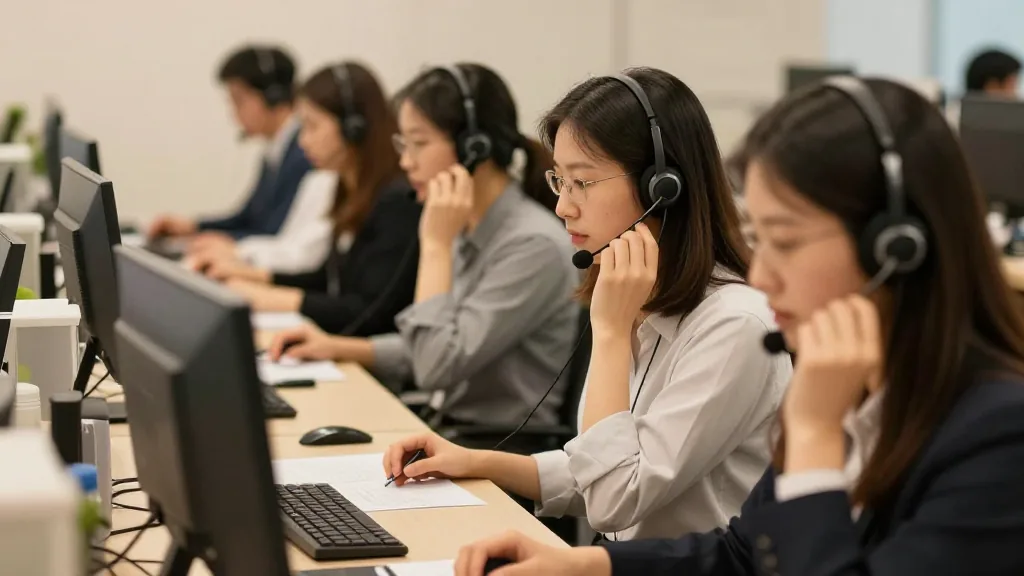
This is the thesis piece on concurrency—the single dimension where the math of a human phone room and the math of one AI line diverge completely. The debate over ai phone answering high concurrency vs call center isn't really about who's friendlier or cheaper per hour. It's about how many callers can be greeted at the same instant, and what happens to everyone in the queue behind them.
The pain isn't the missed call. It's the pile-up behind it.
Every operator knows the individual missed call hurts. What's harder to see is the compounding. When the rush hits, calls don't arrive politely one at a time—they cluster. A reservation question, a takeout order, a "are you still open," a catering inquiry, all inside the same two minutes. The first caller gets a person; the rest hit the wall. Meanwhile your staff is now half-listening to the phone and half-attending to the guest in front of them, so both experiences degrade.
The downstream damage is familiar: the voicemail black hole nobody checks until close, the after-hours gap where the phone simply isn't staffed, the ticket someone jots on a sticky note and re-keys into the POS ten minutes later (introducing an error on the way), the no-show that could have been prevented with a confirmation text, and the caller who switches to Spanish or Chinese and gets put on hold while someone finds "the person who speaks the language." Each of these is a coverage failure, and adding more people only patches part of it—at real cost.
Why a room of agents has a hard ceiling
Human phone coverage is beautifully simple and brutally limited: N seats answer N calls. Caller number N+1 waits. That's the baseline, and the real world only pushes the ceiling lower:
- Breaks and meals. Two of your five seats are away for fifteen minutes and your peak-hour capacity just dropped 40%.
- Shift boundaries. The rush that starts at 6 doesn't wait for the 6:00 shift to fully clock in.
- Sick days and turnover. One caller-out and a training gap can quietly erase a seat for a week.
- Attention split. An agent handling a walk-in or a complex order isn't available for the next ring, even though they're technically "on."
None of this is a knock on the people. A good phone team is an asset. The point is structural: you cannot buy peak capacity you'll only use for ninety minutes a day without paying for those seats all day. So most businesses under-staff for the peak and eat the abandoned calls. That trade-off is the ceiling.
Why one AI has no per-call ceiling
Software concurrency works on a different curve. One AI line answers the first caller and the hundredth caller at the same moment, with no hold music in between. There's no "all agents are busy," because the concept doesn't apply. The way KwickPhone works, each caller gets their own instant, full-attention conversation—it answers every call 24/7 and is never busy.
And crucially, quality doesn't sag under load. Call #1 at 9am and call #100 at midnight get the same greeting, the same patience, the same accuracy. The AI doesn't get short at the end of a double, doesn't sigh, doesn't rush the last caller to clear the queue—because there is no queue and no fatigue.
The honest framing: this isn't AI beating humans at conversation. It's coverage math. A person is often warmer on a hard, emotional call. But no team of people can promise the 40th simultaneous caller the same fresh, correct, courteous experience as the first. Concurrency is where the two models simply aren't playing the same game.
A worked model you can run on your own numbers
Plug in your own figures—these are illustrative inputs, not industry claims. Say your peak hour brings 40 calls, each averaging 4 minutes. That's 160 call-minutes of demand in a 60-minute window, so you'd need roughly 3 seats fully occupied just to keep pace with no slack. Now assume you actually have 2 seats staffed at peak (because staffing 3 all shift is expensive). You can service about 30 of those 40 calls; the other 10 abandon.
Now attach a dollar figure you choose to an abandoned call. If your average phone order or booking is worth, say, $45, and half of those 10 abandoned callers don't call back, that's roughly $225 of walk-away revenue in one peak hour—repeated across your busy shifts. Run the numbers with your real average ticket; the shape holds regardless.
| Peak scenario | Room of 2 human seats | One AI line |
|---|---|---|
| Calls answered at once | 2 | Unlimited (all of them) |
| Caller #3 in the same minute | Hold or voicemail | Greeted instantly |
| During breaks / shift change | Capacity drops | Unchanged |
| After hours | Unstaffed | Fully covered |
| Spanish or Chinese caller | Hold for "someone who speaks it" | Served in-language on the first ring |
| Quality on the 40th call | Rushed under pressure | Identical to the first |
| Result of the call | Message to re-key later | Order/booking completed in the POS |
Concurrency, language, and courtesy are one experience
Here's the part that gets missed when people treat these as separate features. To the caller, they arrive as a single moment. The phone rings once. Someone picks up immediately. That someone speaks their language—English, Spanish, or Chinese, detected and switched automatically, with no "please hold." That someone is warm, patient, and unhurried even though it's the busiest minute of the night. And by the time they hang up, the reservation is booked or the order is fired to the kitchen.
That combination is what produces a satisfied caller. Answered instantly, understood in their own language, treated courteously, task completed on the call. People remember that. It's the difference between a caller who leaves a good review and orders again, and one who hangs up frustrated and tells a friend the phone's always busy. High concurrency without courtesy is just a fast robot; courtesy without concurrency still drops the tenth caller. You need both, plus the language coverage, delivered together.
It completes the task—it doesn't just take a message
Answering fast means nothing if the work still lands on your staff. KwickPhone places the order or reservation directly into the POS—native to KwickOS, or bolted onto Square, Clover, Loyverse, Epos Now, or Revel as an open service. You can see each connector's status and the exact credentials it needs on the integrations page. No transcript to re-key, no sticky note, no error introduced at midnight.
It knows when a human should take over
Concurrency isn't about walling callers off from your team. When the caller asks for a person, when it's an unusually large or VIP order, or when the request is genuinely unusual, the AI transfers cleanly. It also detects prank and abusive calls and declines to fire bogus orders to your kitchen. The design goal: catch the routine, high-volume calls so your people can give full attention to the ones that truly need a human.
A decision framework: is concurrency your real bottleneck?
Adding headcount fixes a staffing problem. It does not fix a concurrency problem. Use this to tell which you have:
- Do your calls cluster? If a big share of your missed calls happen in the same few minutes, you have a concurrency wall, not a staffing gap.
- Is your peak short and sharp? If you'd only use extra seats for 60–90 minutes a day, headcount is the expensive fix.
- Are after-hours calls going dark? No amount of daytime staffing covers the 11pm caller.
- Do you serve callers in more than one language? If "hold for the person who speaks it" is a regular event, that's coverage you can't schedule around.
- Is re-keying tickets a source of errors? Then you don't just need answers—you need completed tasks.
If you checked most of these, you're facing a coverage-math problem, and more seats is the costly patch. Explore how it maps to your trade on the by-trade hub, review plans on the pricing page, and read more category deep-dives on the KwickPhone blog.
Owner controls, and keeping your number
You keep your existing phone number and forward to the AI—on a landline usually *72 followed by the forwarding number (codes vary by carrier, so confirm with yours), or a setting in your VoIP dashboard. Forward all calls, only unanswered ones, or only after-hours. You choose from 20+ voices and personas so it fits your brand, and per-merchant Playbooks encode how your business runs—when to upsell, when to transfer, what to promise on a Friday.
Hear one AI handle the rush
KwickPhone answers every call at once, in your caller's language, and completes the booking inside your POS. Want proof it's not a canned recording? Call our live demo lines at /#try.
Book a demoFrequently asked questions
What does concurrency mean for phone answering?
Concurrency is how many calls can be answered at the same instant. A room of N human agents answers N calls at once; caller N+1 hears hold music or voicemail. One AI answers unlimited simultaneous calls, so the tenth caller in the same minute is greeted as fast as the first.
Is AI phone answering better than a call center for high concurrency?
For sudden spikes it's a different model. A call center scales by adding seats—money, training, time—and its ceiling drops with breaks, sick days, and turnover. One AI has no per-call ceiling and answers call #1 and call #100 with identical speed and quality, day or night.
Does the AI just take a message or actually complete the booking?
It completes the task. KwickPhone places the order or reservation directly into the POS—Square, Clover, Loyverse, Epos Now, Revel, or KwickOS natively—so nothing has to be re-keyed later.
What languages can it handle during a rush?
It greets and converses naturally in English, Spanish, and Chinese, detecting the caller's language and switching automatically. No caller is put on hold for someone who speaks their language—every caller is served on the first ring.
Does call quality drop when many people call at once?
No. The AI stays professional, patient, and polite on every call regardless of volume. The 100th caller at midnight gets the same warm, correct, courteous service as the first caller at 9am, because pressure and fatigue don't affect it.
Related: the complete guide to AI phone answering for restaurants and the best AI phone answering services for restaurants in 2026.