AI Phone Answering for Pizzerias (2026)
The phone at a busy pizzeria doesn't ring once during the dinner rush. It rings a dozen times in forty minutes—and somewhere in that stretch, a hand that should be stretching dough is instead quoting toppings to a caller who'll hang up the moment they feel ignored. The orders that go to voicemail don't disappear. They migrate: to the shop down the street, to a delivery app that takes a percentage, or simply to wherever answers the phone first.
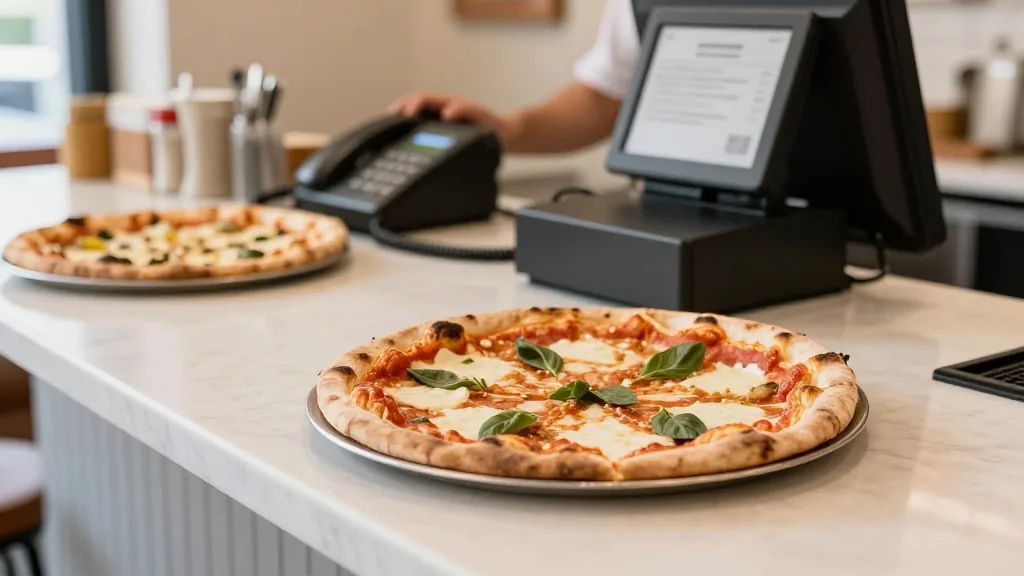
This is the specific problem AI phone answering for pizzerias was built to solve: a system that picks up every call, converses naturally in English, Spanish, or Chinese, places the order directly into your POS, and fires the ticket to the kitchen—without your staff touching the phone. This guide explains how it actually works, what it handles, what to ask before you buy, and the single question that cuts through every vendor pitch.
Why the phone is still a pizzeria's highest-value channel
Counter-intuitive given the rise of ordering apps: the telephone remains the dominant channel for custom, high-value, and catering pizza orders. A caller who wants to specify half-and-half toppings, confirm whether a modifier costs extra, or ask about a gluten-free crust won't trust a form on a third-party app. They call. And when nobody answers—or the line is busy—that complexity, and the larger ticket that comes with it, walks.
The problem compounds at exactly the wrong moment. Dinner service is when your staff has the least bandwidth to pull away from the line, and when callers are the least patient. A phone that rolls to voicemail during the 5–8 pm window isn't a staffing failure. It's a structural gap—one that repeats every shift until you close it.
The one question that separates real AI from a fancy answering machine
Many phone bots answer naturally. Fewer do anything useful after the caller hangs up. Before evaluating any system on features, ask this single question: What happens when a caller orders a large pepperoni with extra cheese for pickup in thirty minutes and then hangs up?
If the answer is "we create a transcript your staff can review," you have a note-taker. If it's "we generate a ticket someone at the counter confirms," that's re-entry wearing a smarter coat. The answer you want is: the order lands in the POS, the kitchen printer fires, and the caller receives a confirmation text—without anyone on your team touching anything.
What POS-native completion looks like in practice
POS-native completion means the AI is connected to the system your kitchen already uses. KwickPhone is native to KwickOS and integrates as an open service with Square, Clover, Loyverse, Epos Now, and Revel—so a phone order appears in the same ticket queue as a counter order or an online order. No second screen, no translation layer, no re-keying.
The modifiers are the real test. "No sauce on the left half, double cheese on the right, sub sausage for the pepperoni" is a completely ordinary pizza order. If the AI maps that to the correct items and modifiers in your POS, it's grounded on your real menu. If it approximates, invents an item, or misses the modifier, you have a ticket the kitchen can't make and a caller who will not order again.
A phone bot that cannot write to your POS is a transcription service with a voice. The only measure that counts: does the ticket land in the kitchen with the right items and the right modifiers?
Every call type a pizzeria actually receives—handled
A capable AI front desk handles the full range of what your phone sees in a real shift, not just clean, simple orders.
| Caller's request | Without AI | With KwickPhone |
|---|---|---|
| "Large pepperoni, extra cheese, pickup in 30" | Staff stops what they're doing to take the order | Placed in POS, kitchen ticket fires, caller gets a confirmation text |
| "Table for six at seven on Saturday?" | Host checks the book or asks someone to | Booked into the reservation system, confirmed by text |
| "What time do you close tonight?" | Diverts a team member mid-task | Answered instantly from your live hours |
| "Do you have a gluten-free crust?" | Someone has to know and be available to answer | Answered from your real menu, correctly |
| "¿Hacen pizzas sin gluten?" | Often missed or misunderstood | Handled in Spanish, automatically |
| Three calls at once at 6:45 pm | Two go to voicemail | All three answered simultaneously |
Beyond orders and reservations, the same system fields questions about parking, allergens, delivery radius, catering availability, gift-card balances, and loyalty points—answered from your actual policies, not a generic script.
Multilingual ordering—the neighborhood reality
Pizza is neighborhood food. Your neighborhood may speak English, Spanish, Mandarin, or all three before noon on a Saturday. A caller who can't comfortably describe their order in English doesn't disappear from the market—they find somewhere else that makes ordering easier.
KwickPhone detects the caller's language within the first sentence and switches automatically. The same menu grounding applies in every language, so a Spanish-speaking caller's request maps to the identical ticket a native English-speaking caller's would. Multilingual service doesn't require multilingual staff on every shift; the AI handles it for every call, every hour.
Handling the dinner rush without dropping a call
The defining physics of a phone rush: calls pile up at the exact moment your staff has the least capacity to take them. A single host answers one call at a time. An AI system answers as many calls as ring simultaneously.
During a Friday dinner window, that concurrency is where the most revenue hides—not in any individual call, but in the third and fourth calls that used to hit voicemail while the first two were still being taken. Every one of those was a caller with a real order, not a browser who clicked away.
More on this on the pages for answering during the rush and taking phone orders at a pizzeria.
Prank and abuse detection
A system that acts on every instruction it hears is a system waiting to be exploited. KwickPhone detects obvious prank and abusive calls, declines to place bogus orders, and can flag repeat offenders. Your kitchen line stays clear of tickets nobody is coming to pick up.
When a human should still take the call
The goal of AI phone answering isn't to remove people from your operation. It's to remove people from the calls that don't need them—so your staff can give their full attention to the calls that do.
KwickPhone transfers to a live team member when:
- The caller asks for a person. Caller preference always wins, immediately, with no friction.
- The order is unusually large: a catering run, a bulk order for an event, anything where a human relationship adds value.
- The caller is a known VIP who expects personal service.
- The request is genuinely outside what the AI can safely handle.
Single-location pickup, a standard reservation, a question about hours—the AI handles those completely. Your team gets the complex, high-touch calls and stays off the phone for everything else. A system that traps callers in a bot with no escape is a worse experience than the missed call it replaced.
Owner controls built for a pizza operator
You shouldn't need to file a support ticket to pull a topping off the menu or extend Friday hours. KwickPhone puts the operator in charge without requiring you to be a developer.
- Per-merchant Playbooks. Rules that encode how your shop runs: always upsell the two-liter, never quote under 35 minutes on a Friday, transfer any catering order over eight pies to the manager, offer loyalty signup to every first-time caller. Your logic, applied to every call.
- Voice management by voice. Update hours, flip a sold-out item, or pause ordering with a spoken command—useful when you're behind the counter and not near a laptop.
- 20+ voices and personas. Choose a voice that fits your brand—a warm, neighborhood-pizza tone or a sharper, efficiency-first style. Each location can have its own persona.
Setup: keep your number, forward in two steps
You don't get a new phone number. You keep the line your regulars already have saved in their contacts.
Forwarding works the same way it has for years. On a traditional landline, the most common activation code is *72 followed by the KwickPhone number—this tells the carrier to forward all calls. To deactivate, dial *73. Codes vary by carrier, so confirm the exact sequence with yours before setup. On a VoIP line, you set the forwarding rule in your provider's dashboard, typically a two-minute change.
You can forward every call, only calls that go unanswered after a set number of rings, or only calls that arrive outside business hours. Many pizzerias route all calls through the AI during the dinner rush—when every available hand is in the kitchen—and switch to ring-first-then-AI during slower periods. The configuration is yours to adjust anytime.
Want to hear what the system actually sounds like before you decide? You can call our live demo lines at /#try—real calls, not canned recordings.
See AI phone answering built for pizzerias
KwickPhone answers every call and places the order natively into your POS—or bolts onto Square, Clover, Loyverse, Epos Now, or Revel. Hear it live before you commit: call our demo lines at /#try.
Book a demoFrequently asked questions
What is AI phone answering for pizzerias?
A voice assistant that answers your pizzeria's phone, understands what the caller wants, and completes the task—taking orders, booking reservations, answering questions about hours or menu—24/7, with no caller left on hold and multiple calls handled simultaneously.
Does the AI actually place the pizza order into the POS, or just take a message?
A real system places the order directly into the POS and fires the ticket to the kitchen. Systems that only take a message still require your staff to re-key the order—reintroducing the delay and error risk the AI was supposed to eliminate. Ask any vendor precisely what happens after the caller hangs up.
Can it handle multiple callers at the same time?
Yes. Unlike a human host who can take one call at a time, AI phone answering handles as many concurrent calls as ring simultaneously. This is especially valuable during the dinner rush, when overflow calls previously went to voicemail.
What happens if the caller wants to speak to a person?
The call transfers immediately. KwickPhone also transfers for unusually large orders, known VIP callers, and any request outside what it can safely complete. The AI handles routine calls; it never walls callers off from your team.
Do I have to get a new phone number?
No. You keep your existing number and forward calls to the AI line—usually a code like *72 on a traditional landline (verify the exact code with your carrier) or a setting in your VoIP dashboard. You can forward all calls, only unanswered ones, or only after-hours calls.
Related: The complete guide to AI phone answering for restaurants and the best AI phone answering services for restaurants in 2026.