AI Phone Dispatch for Taxi & Car Services: Never a Busy Signal
It's 1:40 on a Saturday morning and every dispatcher in the room has a phone pinned to one ear. The board is full, the radio is crackling, and the lines keep lighting up because the bars just let out. Three of those blinking lines will ring out, hit voicemail, and hang up. Each of them was a fare — and every one of them just dialed the company on the next page of the search results. That's the cruel arithmetic of a taxi phone room: your busiest, most profitable minutes are exactly the minutes you physically cannot answer the phone.
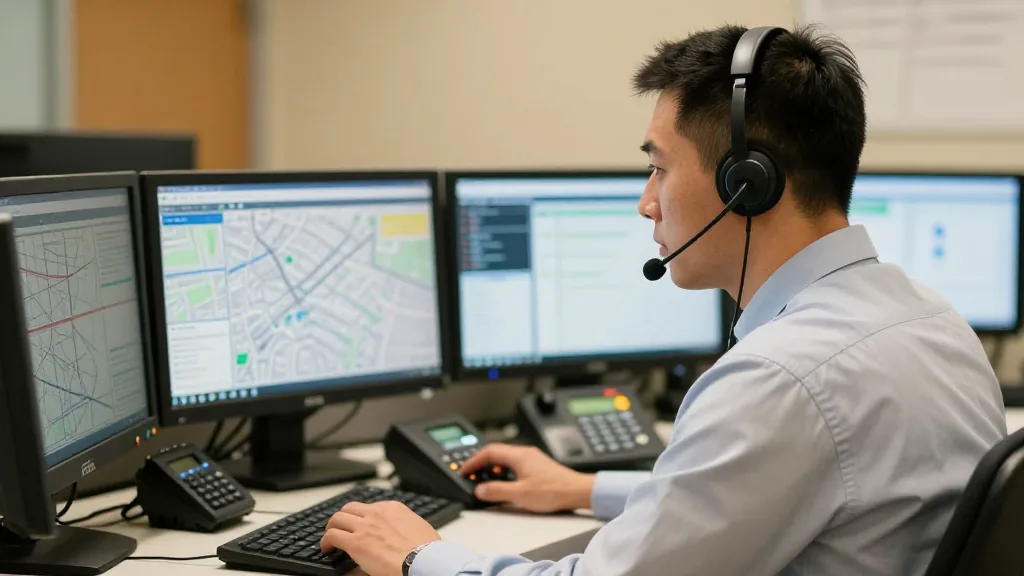
This guide is about closing that gap. Specifically, it's about AI phone answering for taxi and car service dispatch — software that picks up every ride-booking call the instant it rings, captures pickup, dropoff, and time, books the job, and does it for the tenth caller at midnight as warmly as the first caller at nine in the morning. Not a message-taker. A dispatcher that never runs out of hands.
The peak-hour ceiling nobody can staff around
A human dispatcher is excellent — quick, local, able to read a regular's shorthand and know exactly which corner "the usual by the pharmacy" means. But one dispatcher can hold exactly one conversation. Two dispatchers, two calls. That's the ceiling, and it's a hard one.
The trouble is that demand for a taxi service isn't smooth. It spikes, hard and predictably, at the worst possible moments:
- Bar close. A wall of calls arrives in a 20-minute window when everyone leaves at once.
- Airport rushes. Flights land in clusters; a wave of arrivals all want a car in the same ten minutes.
- Bad weather. Rain or snow means everyone who'd normally walk or drive suddenly needs a ride — right when road conditions already slow your fleet.
- After hours. The 4 a.m. hospital run or early-flight pickup that comes in when the phone room is a single tired person, or nobody at all.
Staffing for the peak means paying idle dispatchers through the slow hours. Staffing for the average means the peak overflows into voicemail — the black hole where booking calls go to die, because a rider who wants a car in twenty minutes will not wait for a callback. And every overflow call isn't just a lost trip fare; it's a lost regular. The rider who couldn't get through learns to dial someone else first.
Do the math with your own numbers: take a normal Friday-night surge and count the calls that ring out or hit voicemail. Multiply by your average fare. That's not a projection from us — it's your own recurring leak, happening every weekend at the same time.
What "AI phone answering" actually means here
Set aside the buzzwords. For a dispatch operation, an AI phone agent is a voice assistant that answers the line, understands a natural spoken booking — "yeah I need a car from 120 Elm to the airport, terminal two, in about fifteen minutes" — and turns it into a real dispatched job. It works around the clock, it's never busy, and it handles many calls at the same instant.
The important word is completes. A cheap phone bot records what the caller said and drops a transcript on someone's screen to re-key. That's just voicemail with better handwriting — and re-entry is slow and error-prone at exactly the moment your team has no spare seconds. A real system books the ride directly in the software that runs your operation, so the job lands where dispatchers already look. If you want to see the plumbing behind that, how KwickPhone works walks through the answer-understand-act loop step by step.
It's native to KwickOS — or it bolts onto what you run
KwickPhone is native to the KwickOS platform, but it also works as an open service on top of the systems you may already use for booking and payments — our integrations page shows each connector's live status and the exact credentials it needs, including partners such as Square, Clover, Loyverse, Epos Now, and Revel. The point is that the AI doesn't sit in a silo; it writes the booking into the tool your dispatchers trust.
Concurrency, language, and courtesy — one experience, not three features
Here's the thing operators miss when they evaluate this by feature checklist: for the caller, three separate capabilities blur into a single moment of relief. The phone is answered on the first ring even though it's the busiest minute of the night. The greeting comes in their own language without them having to ask. And the voice is patient and polite, not clipped and rushed. Together, that's the difference between a rider who hangs up booked and happy and one who hangs up frustrated.
One agent, every line at once
Where your human bank tops out at however many dispatchers you have on shift, the AI answers as many concurrent calls as ring. Fifty calls at bar close don't queue behind each other — they're all answered simultaneously, each caller getting a real conversation, each booking captured in parallel. Nobody hears a busy signal. Nobody is parked on hold listening to a "your call is important to us" loop while your fleet fills up.
English, Spanish, and Chinese on the first ring
Taxi calls come from everyone. In a lot of neighborhoods, a meaningful share of riders are more comfortable in Spanish or Chinese than English — and the old workaround was to put them on hold while someone hunted for a bilingual dispatcher, or to muddle through and risk getting the pickup address wrong. KwickPhone greets and converses naturally in English, Spanish, and Chinese, detecting the caller's language in the first sentence and switching automatically. No hold. No embarrassment. No transposed address because two people misheard each other across a language gap.
The 100th caller gets the same warm service as the first
This one is honest about human limits without disparaging anyone. A dispatcher who has answered ninety calls in a storm is human — tired, terse, maybe short with the caller who can't remember their cross street. That's not a character flaw; it's pressure. The AI doesn't have a bad night. It's professional, patient, and courteous on call one and call two hundred, at 9 a.m. and at midnight, in the calm and in the surge. That consistency is what quietly lifts your reviews and your repeat business: riders remember being answered instantly, understood in their language, and treated well — so they call you first next time.
A Friday-night surge, worked through
Before. 1:38 a.m. Two dispatchers, both mid-call. Six lines ringing. Three ring out to voicemail; two of those callers immediately dial a competitor. One Spanish-speaking caller gets picked up, asked to hold for "someone who can help," and hangs up. By 2:00 a.m., the board has the trips your team could physically key in — and a voicemail box full of fares that already found another ride.
After. Same 1:38 a.m. All six lines answered on the first ring. The caller at 120 Elm gets a car booked to terminal two for a 15-minute pickup, confirmed by text. The Spanish-speaking caller is greeted in Spanish, books a downtown run, and never once feels like a problem. A regular who slurs "the usual spot" is politely asked to confirm the address rather than guessed at. Your two human dispatchers, meanwhile, are freed to handle the one genuinely complicated call — a five-car group booking — with their full attention. Nothing hit voicemail. Nobody got a busy signal.
| Surge-hour situation | Human phone bank alone | With an AI dispatch agent |
|---|---|---|
| Six calls ring at once | Two answered, four to voicemail | All six answered simultaneously |
| Spanish or Chinese caller | Hold for a bilingual dispatcher, or muddle through | Served in their language on the first ring |
| Tired dispatcher, 90 calls in | Rushed, occasionally curt under pressure | Same patient, polite tone every call |
| 4 a.m. early-flight booking | Voicemail if the room is empty | Answered and booked 24/7 |
| Prank or abusive call | Ties up a live person | Detected, declined, flagged |
| Large or VIP group booking | Handled by whoever's free | Transferred to a human on purpose |
Knowing when to hand a call to a person
A good AI agent stays in its lane. It should catch the high-volume routine bookings — the single-car, point-A-to-point-B rides that make up the bulk of your calls — and deliberately transfer the ones that deserve a human:
- The caller simply asks for a person. Caller preference always wins.
- A large or multi-vehicle booking, a corporate account, or a known VIP who deserves a personal touch.
- Anything genuinely unusual — a complicated multi-stop route, a special-needs request, a complaint.
It also recognizes obvious prank or abusive calls, declines to dispatch a bogus car, and can flag repeat offenders instead of quietly sending an empty vehicle across town. The goal is coverage, not walling callers off from your people.
Owner controls: it sounds like your company
You're in charge without needing to be a developer. Pick from 20+ voices and personas so the agent matches your brand — a warm neighborhood-cab feel or a crisp black-car tone. Then set per-merchant Playbooks: the rules for how your operation runs. Always confirm the exact pickup address. Quote a realistic ETA, never an impossible one, during a surge. Offer an account customer their saved home address. Transfer airport group bookings to the desk. You can even update instructions by secure voice command when you're not at a laptop.
Setup: keep your number, forward the calls
You do not change your phone number — the number riders already have saved. You keep your existing line and forward it to the AI. On a traditional landline that's usually a call-forwarding code such as *72 followed by the forwarding number (codes vary by carrier, so confirm with yours); on VoIP you point the number in your provider's dashboard. Forward all calls, only the ones your dispatchers don't pick up, or only calls outside staffed hours — so the AI becomes your always-on overflow and night desk while your team runs the board during the day.
A short decision checklist for dispatch operators
- Does it complete the booking in my system, or just transcribe a message someone re-keys? Ask exactly what happens after hangup.
- How many calls can it take at once? Concurrency is where your surge-hour revenue lives.
- Does it speak my riders' languages — and switch automatically without a hold?
- Does it stay warm and correct under load, and transfer VIP or complex jobs to a person?
- Can I change voices, ETAs, and rules myself, instantly, without a support ticket?
- Can I hear it live before I buy? A real call beats a slide deck.
If you want to compare across trades, the by-trade hub lays out how this plays out for different businesses, and the taxi & car service page gets specific to dispatch. Pricing is transparent on the pricing page, and there's more category background over on the KwickPhone blog.
Hear it take a booking call at 1 a.m.
KwickPhone answers every ride-booking call, in English, Spanish, or Chinese, and completes the job in your system — no busy signal, no voicemail black hole. Want to hear how it sounds? Call our live demo lines (real calls, not canned recordings) at /#try.
Book a demoFrequently asked questions
What is AI phone answering for taxi and car service dispatch?
A voice assistant that answers every booking call the moment it rings, captures pickup, dropoff, and time, and completes the booking in your dispatch or POS system — 24/7, several callers at once, with no one left on hold or sent to voicemail.
Can it handle a Friday-night surge when all my dispatchers are busy?
Yes. Human dispatchers each take one call at a time, so during bar-close or an airport rush the extra callers get a busy signal or voicemail. The AI answers as many calls as ring at once, so the fifth and tenth caller are booked instead of lost to the next company.
What languages does it speak?
It greets and converses naturally in English, Spanish, and Chinese, detecting the caller's language in the first sentence and switching automatically — so no caller is put on hold waiting for someone who speaks their language.
Does it just take a message, or actually book the ride?
The best systems complete the booking directly in your dispatch or point-of-sale system rather than leaving a note someone must re-key. It captures the pickup address, destination, time, and passenger details and drops the job where your dispatchers already look.
Do I have to change my phone number?
No. You keep your existing number and forward calls to the AI line — usually a code like *72 on a landline (codes vary by carrier) or a setting in your VoIP dashboard. Forward all calls, only unanswered ones, or only after-hours calls.
Related: the complete guide to AI phone answering and the best AI phone answering services compared for 2026.