AI Phone Answering for Wine Bars (2026)
It's 7:45 on a Saturday. Your sommelier is mid-pour explaining a Ribera del Duero to a curious table, the host is walking a party through the reserve bottle list, and the bartender is deep into a four-glass flight explanation. The phone rings. Nobody moves. After four rings it goes to voicemail—and somewhere across town, a couple who wanted to book a birthday reservation decides to try the wine bar two blocks down instead. That one call is gone, and nobody in your venue even knows it happened.
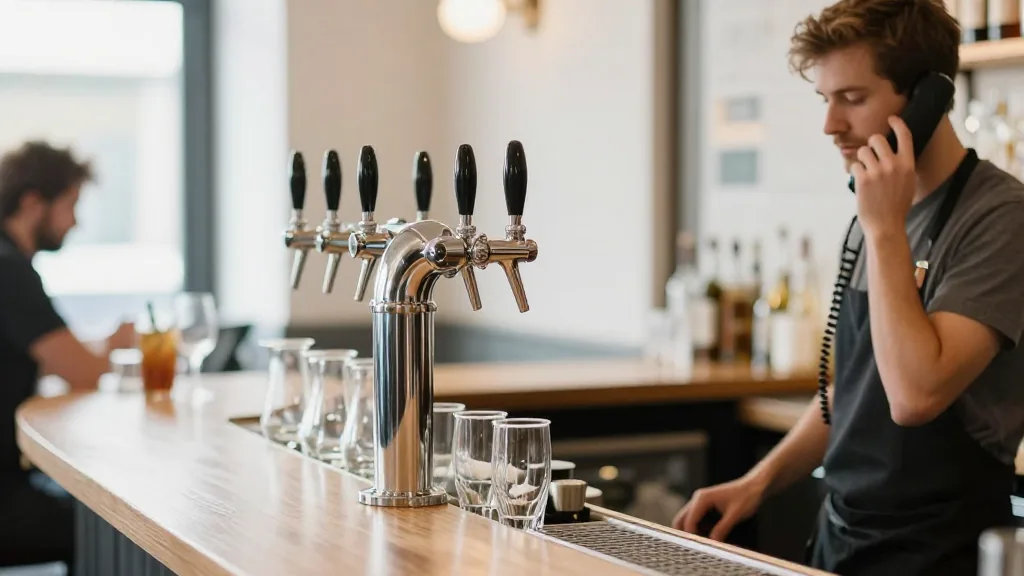
This is the practical guide to AI phone answering for wine bars: what it actually does, why wine bars are particularly exposed to the missed-call problem, and what separates a system that creates real value from one that just takes a polished message nobody acts on.
The calls you are losing right now—and why they sting more at a wine bar
Every hospitality business loses calls during peak service. But wine bars have a structure that makes each missed call more costly than a typical restaurant: revenue is heavily reservation-driven, average checks run higher, and callers often need a moment of guidance before they commit—"do you have a private area for twelve?" or "are you doing a tasting event this week?" Those are not impulsive quick orders. They are considered bookings from guests who were ready to say yes.
The gaps show up in a predictable pattern:
- Friday and Saturday evenings — your highest-revenue windows are exactly when every staff member is engaged and the phone goes unanswered.
- The voicemail black hole — callers who want a reservation tonight rarely leave a message and wait. They move on. By the time someone plays the voicemail, the caller has already booked elsewhere.
- After-hours booking intent — wine bar guests often plan weekend outings on weekday evenings after 10 p.m., when your venue is closed or winding down and no one is picking up.
- No-show creep — a reservation taken verbally over the phone, written on a notepad, never entered into the POS, is a reservation that never gets a confirmation text. No text means no reminder, and no reminder means a table that sits empty on a busy Saturday.
- Re-keying friction — even when staff do answer and take a reservation, writing it on paper and entering it into the system later introduces errors. A party of four becomes a table set for two; a 7:30 becomes an 8:30.
- Language barriers — wine culture draws a genuinely diverse clientele. A caller who speaks Spanish or Chinese and hears only silence or a generic English voicemail quietly decides you are not a place that welcomes them.
Why wine bars are structurally different from casual dining
A pizza counter can absorb a missed call more gracefully—a guest who wanted a pickup order simply orders online instead. Wine bars rarely have that escape valve. The phone is often the primary booking channel because the visit requires more than a tap on an app: it requires trust. Callers want to know you exist, that a table will be waiting, and sometimes that there is a by-the-glass pour of a particular grape they read about. That relationship starts on the phone.
The call volume is also concentrated—not spread across the day. A wine bar might receive the majority of its weekly reservation calls in a four-hour Friday window. Miss that window, and the weekend is already thinner than it had to be. The wine bar operator hub on KwickPhone's /for/ directory breaks down how this contact pattern differs from daytime food-service venues, if you want a side-by-side look.
What AI phone answering actually does for a wine bar
At its simplest: it answers every call, at any hour, with no caller ever reaching voicemail unless you specifically route it that way. But the mechanics matter, because not every system is equal.
Instant, natural-language answers
The caller speaks the way they would to a host—"do you have a table for two tonight around eight?"—and the AI responds from your real availability, hours, and policies. There is no "press 1 for reservations." The conversation flows. The system tracks context across multiple turns, so if the caller says "make it three, actually," it adjusts the party size without making them start over.
Reservations booked directly into the POS
This is the step that separates a genuine tool from a clever answering machine. When the AI confirms a reservation, it places that booking into the same system your team is already looking at—party size, time, name, phone number, and any special requests captured. No paper slip, no re-keying, no gap between what the caller heard and what the host stand sees. The confirmation text goes out automatically. For wine bars on Square, Clover, Loyverse, Epos Now, or Revel, the integrations directory shows which connectors are live and what credentials each one requires.
Wine list and event inquiries answered from your real data
The system is grounded against the information you provide—your current by-the-glass list, flight options, weekly events, private dining availability, and policies. It does not invent a wine you stopped carrying or promise a private room that is already booked. For nuanced curation questions—"what would you recommend with our charcuterie board?"—it transfers the caller to your sommelier rather than improvise an answer that could mislead a guest.
Concurrent calls, all answered
When two reservation calls arrive at once during peak hours, both are answered simultaneously. There is no queue, no second caller waiting on hold listening to hold music. This concurrency is where much of the real value hides—not in any individual call, but in the calls that previously overflowed to nothing.
The one question that separates a real system from a smarter voicemail
Ask any vendor exactly what happens after the caller hangs up. If the answer is "it sends your team a transcript" or "someone on staff confirms the booking in the morning," that is manual re-entry in disguise. The call was answered, but the work was not done.
A phone system that takes a reservation but does not write it into your POS is a notepad with a voice. The value is completion: the booking exists in the system your host stand trusts, the confirmation text has already gone out, and no one on your team had to do anything.
For a wine bar, this distinction is especially sharp on private-room and event inquiries. A system that books standard tables natively but flags complex private-event requests for a human callback is doing exactly the right thing—covering the high-volume routine work so your team can handle the high-touch exceptions with full attention.
The full range of calls a wine bar AI system handles
- Standard reservations — booked into the floor plan with party size, time, name, phone, and any special requests.
- Hours and directions — including "are you open right now?" and holiday hours.
- By-the-glass and flight availability — answered from your current list, not a generic script.
- Event and tasting night information — details you provide about upcoming programming.
- Private dining inquiries — captures details and flags for human follow-up when the scope requires it.
- Gift card balance checks and sales — over the phone, without a staff member.
- Loyalty enrollment and lookup — for wine bars running a loyalty program.
- Payment by SMS — a secure link texted to the caller so a deposit or pre-payment is handled before the visit.
- Reservation reminders — automatic follow-ups that reduce no-shows without any staff action.
| Caller's request | Unanswered / voicemail | AI phone answering |
|---|---|---|
| "Table for two tonight at eight?" | Goes to voicemail; caller books elsewhere | Booked into POS instantly; confirmation text sent |
| "Do you have any natural wines by the glass?" | No answer until someone calls back | Answered from your current list in real time |
| "Can we reserve the back room for sixteen?" | Message left, often missed | Details captured; flagged for human callback same day |
| "What time do you close on Sundays?" | Generic voicemail, no answer | Answered accurately from your current hours |
| "¿Tienen mesas disponibles para el viernes?" | English-only voicemail, caller disengages | Answered in Spanish; reservation booked in POS |
| Three calls arrive at once on Saturday at 7 p.m. | Two go to voicemail | All three answered simultaneously |
Multilingual service without multilingual hiring
Wine culture is genuinely international, and so is the clientele it draws. KwickPhone handles calls in English, Spanish, and Chinese and detects the caller's preferred language within the first few seconds of the conversation, switching automatically. A Spanish-speaking caller who wants a Friday reservation gets the same fluent, patient experience as an English speaker—and the booking lands in your POS with exactly the same accuracy. For neighborhoods where language is a real factor in who feels welcome at your venue, this is not a minor feature. You can explore how the multilingual capability layers with your existing POS on the integrations page, which lists each connector's supported languages alongside its required credentials.
Smart handoffs: when the AI steps aside
A well-designed system knows its limits. KwickPhone transfers a call to a human when:
- The caller asks to speak with a person—caller preference always wins, immediately.
- The inquiry is a large private event, a VIP guest the system flags, or anything that genuinely benefits from a personal touch.
- The request falls outside what the system can safely complete—an unusual dietary situation, a complex catering negotiation, anything where improvising could mislead a guest.
The goal is not to replace your team's judgment. It is to take the high-volume, high-frequency calls off their plates so that when a call does reach a human, that person has the space to give it proper attention. A system with no escape hatch—one that traps a caller in a loop with no way out—creates a worse experience than the voicemail it replaced. See how KwickPhone handles the handoff logic in detail.
Owner controls and customization
You do not need to file a support ticket to update your hours for a holiday or pull a wine from the by-the-glass list when it sells out. The platform is built for owner-level control:
- Voice management commands. Speak a secure command to flip a wine to sold-out, update tonight's closing time, or pause reservations—useful from the floor, not just from a laptop.
- Per-merchant Playbooks. Rules that encode how your wine bar runs: always mention the Thursday tasting event, transfer any party over ten to the manager, never promise the back room without a deposit confirmation.
- Voice and persona selection. A library of 20+ voices and personas so the AI host sounds right for your brand—warm neighborhood spot, polished tasting-room curator, or anything between.
For a full picture of what each plan unlocks, the pricing page breaks down Playbook depth and voice-library access by tier. The broader trade directory also shows how wine bars compare to other hospitality verticals in terms of typical call patterns and feature use.
Prank and abuse detection
A wine bar that runs reservations is an easy target for prank bookings—fake party-of-twenty entries that hold tables for no one. KwickPhone includes detection for obvious abuse patterns and repeat offenders, declining to place bogus reservations and flagging suspicious call behavior rather than dutifully writing fake bookings into your floor plan.
Setup: your number stays, your POS stays
You do not change your phone number. You keep your existing line and forward calls to KwickPhone. On a traditional landline, this is typically a forwarding code—commonly *72 followed by the AI line number to activate and *73 to deactivate—though the exact codes vary by carrier, so confirm with yours before the first night. On VoIP, you set the forward in your provider's dashboard in under a minute. You can route all calls, only unanswered rings, or only calls outside your open hours. KwickPhone is native to the KwickOS platform and also bolts onto Square, Clover, Loyverse, Epos Now, and Revel as an open service, so your POS stays exactly where it is. Review the connection setup steps for your specific system on the integrations page before you go live.
A realistic before and after
Before. It's 8:05 on a Friday. Every staff member is engaged—host, bartender, sommelier, floor. The phone rings twice and goes quiet. The caller, who had planned a Saturday birthday dinner for eight and was ready to put down a deposit, heard silence and assumed you were too busy to care. They booked the other place. Over a Saturday evening, that scene may repeat itself several times, and every instance is invisible to your team because no voicemail was left and no record exists.
After. The same 8:05 call is answered on the first ring by an AI host that knows your reservation availability, your private-room policy, and the fact that you require a deposit for parties over six. It takes the birthday dinner inquiry, confirms the Saturday slot, texts a deposit link, and places the booking in the POS—while simultaneously answering a by-the-glass question from another caller and booking a two-top for Sunday from a third. Your staff never broke stride, and three calls that would have been invisible are now on the books.
See AI phone answering built for wine bars
KwickPhone answers every call and writes reservations directly into your POS—or connects to the system you already run. Want to hear how it actually sounds before you decide? Call our live demo lines at /#try—real calls, not canned recordings.
Book a demoFrequently asked questions
Can AI handle calls about wine selections, flights, and bottle inquiries?
Yes. The system is grounded against your actual list—by-the-glass pours, flights, and notes you provide. It answers from real data. For deeper curation questions ("what pairs best with the aged cheddar?"), it transfers to your sommelier rather than guess—protecting your guests from bad advice and protecting your reputation from the same.
Does it handle reservation bookings for events and private tastings?
Yes for standard reservations—those land in the POS with full details and a confirmation text. For larger private-event or tasting-night inquiries that require back-and-forth, it captures the caller's details and flags the inquiry for human follow-up so nothing goes unrecorded.
What happens when a caller wants a large party or is a VIP?
The system transfers to a human immediately. It catches the high-frequency routine calls so your team can give their full attention to the calls that deserve it. Caller preference also always wins—if someone simply asks to speak with a person, the transfer happens without friction.
Can it serve callers who speak Spanish or Chinese?
Yes. KwickPhone detects the caller's language within the first few seconds and switches automatically. English, Spanish, and Chinese are all supported, and the same reservation accuracy applies in each—the booking in your POS reads correctly regardless of the language the call was conducted in.
Do I have to change my wine bar's phone number?
No. You keep your existing number and forward calls to KwickPhone—usually a code like *72 on a landline (verify with your carrier) or a setting in your VoIP dashboard. Forward all calls, only unanswered ones, or only after-hours calls—whichever fits how you run service.
Related: the complete guide to AI phone answering for restaurants and the best AI phone answering services for restaurants in 2026. You can also browse all KwickPhone blog guides or review the full how KwickPhone works page for a deeper technical walkthrough.