AI Phone Answering for Vietnamese Restaurants (2026)
It's 12:15 on a Saturday. The pho pot is at a rolling boil, three servers are ferrying banh mi to the counter, and the phone rings for the fourth time in ten minutes. Someone wants a large pho tai, extra basil, no onions, plus two spring rolls—maybe $35 on the ticket. Nobody can grab the line. The caller hangs up after five rings and orders from the place two blocks over. That call didn't just cost you $35; it cost you a regular who now knows the other spot answers.
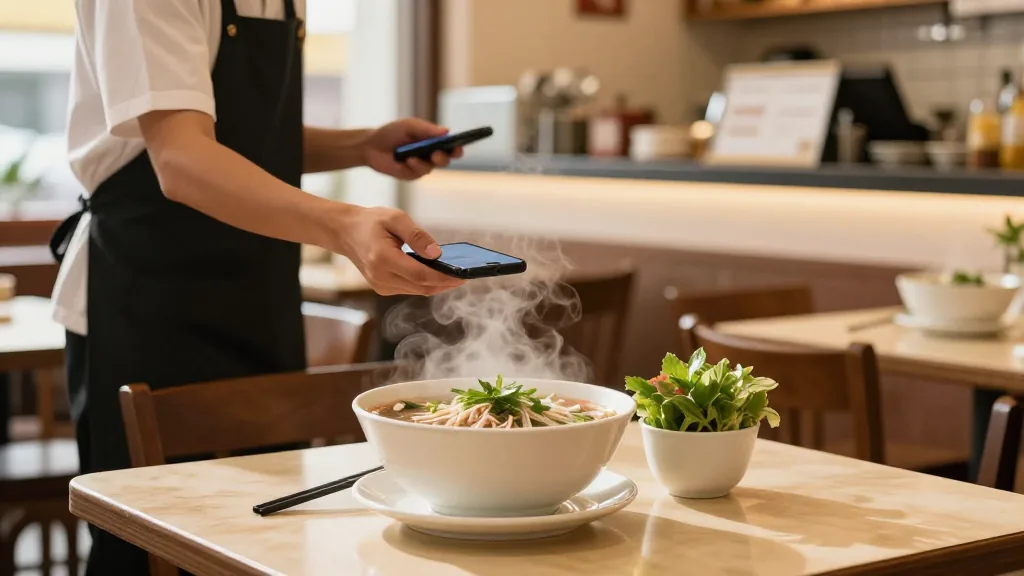
Vietnamese restaurants live and die on phone volume. Takeout is a huge share of revenue, orders are detailed, and a real slice of your callers are more comfortable speaking Vietnamese, Spanish, or Chinese than English. This guide is about AI phone answering for Vietnamese restaurants—not as a buzzword, but as a specific tool for the specific calls you're losing right now.
The calls you're actually losing (and what they're worth)
Before the fix, be honest about the leak. For a Vietnamese takeout-heavy kitchen, the phone bleeds in four predictable places:
The lunch and dinner rush overflow
Your single busiest windows are exactly when nobody can pick up the phone. The second and third caller during the noon rush go to voicemail. Run your own math: if you miss even a handful of $30 orders across a busy Friday and Saturday, and you're open most days, that's a serious monthly number—use your own average ticket and your own guess at missed calls to size it. Those aren't invented figures; they're your inputs. The point is the number is rarely small.
The voicemail black hole
Most restaurant voicemail never gets returned before the caller has already eaten somewhere else. A pho order isn't a "call me back tomorrow" request—it's a "I'm hungry in the next 30 minutes" request. A message left at 12:20 that you hear at 2:30 is a lost sale, full stop.
The language barrier
An older caller who speaks limited English, or a Spanish-speaking neighbor, may struggle with a rushed host who's balancing three trays. The call gets short, the order gets garbled, or the caller just gives up. That's revenue and goodwill walking out the door.
Re-keying and after-hours gaps
Even when you do catch the call, someone scribbles it on a pad and re-enters it into the POS—slow, error-prone, and a great way to send out a bowl with onions the caller specifically refused. And the calls that ring at 9:45 PM, after the counter's cleaned but before you've technically closed the online ordering? Pure lost margin.
Rule of thumb: any phone tool that only records what the caller said hasn't solved your problem—it's just moved the re-keying to later. The value is in the order landing on the kitchen line, correct, the first time.
What AI phone answering actually does
An AI phone agent answers your restaurant's line, understands the caller in natural speech, and completes the task: it places the takeout order, books the table, answers "are you open right now?", checks a gift-card balance, or texts a payment link. It works around the clock, never puts a guest on hold, and picks up several calls at once. The caller just talks the way they'd talk to your host—no "press 1 for hours."
The difference that matters for a Vietnamese kitchen is grounding. KwickPhone is grounded on your real menu, so it knows the difference between pho tai and pho tai chin, understands "extra basil" and "no onions" as real modifiers, and won't invent a dish or quote a price that doesn't exist. See exactly how that pipeline works on how KwickPhone works.
The one question that separates real from fake
When you evaluate any vendor, ask precisely what happens after the caller hangs up. If the answer is "we send your staff a transcript" or "we create a ticket someone confirms," that's manual re-entry in a nicer outfit. The systems worth paying for either are your POS or integrate deeply with it.
KwickPhone is native to KwickOS, and it bolts onto the ordering systems you may already run as an open service—Square, Clover, Loyverse, Epos Now, and Revel. So the pho order fires straight to the kitchen where your line cooks already look. Before you commit, check the integrations directory, which shows each connector's live status and the exact credentials you'll need to connect it—for example the Square connector or the Clover connector if that's what runs your counter.
Handling a Vietnamese menu, correctly
Vietnamese orders are modifier-dense, and that's exactly where cheap bots fall apart. A capable system maps messy spoken orders to your real items:
- Size and protein combos — "large pho tai, side of tripe" resolves to the right item and add-on.
- Herb and topping requests — "extra basil, no bean sprouts, no onions" become the real modifiers your kitchen ticket expects.
- Spice and sauce — "extra sriracha on the side," "no fish sauce."
- Common phonetic variants — callers pronounce dishes many ways; grounding on your menu keeps the match tight.
Three languages, one kitchen ticket
KwickPhone answers in English, Spanish, and Chinese, detecting the caller's language within the first sentence and switching automatically. For a Vietnamese restaurant in a mixed neighborhood, that means a Spanish-speaking regular and an English-speaking office manager both get a fluent, patient host—without you staffing a multilingual person on every shift. Crucially, the same menu grounding applies in every language, so a Spanish caller's order produces the same correct kitchen ticket an English caller's would.
| Caller's request | Voicemail / basic bot | KwickPhone |
|---|---|---|
| "Large pho tai, no onions, extra basil" | Message; re-keyed later, onions risk | Placed in POS with exact modifiers, fired to kitchen |
| "Table for six at 7?" | No answer until someone checks | Booked, confirmed by text |
| "¿Están abiertos ahora?" | English only, caller hangs up | Answers live hours in Spanish |
| Four calls at once, Friday lunch | Three go to voicemail | All four answered simultaneously |
| Catering order for 40 | Rushed, error-prone note | Transferred to the manager |
Surviving the real Saturday rush
A demo on a quiet line is easy; noon on a weekend is the real test.
Concurrency
Your host answers one call at a time. KwickPhone answers as many as ring at once, so the fourth caller during the rush gets a host, not voicemail. That overflow is often where the biggest recovered revenue hides—not in any single call, but in the pile that used to spill over.
Prank and abuse detection
The system recognizes obvious prank or abusive calls, declines to act, and won't send ten bogus pickups to your kitchen.
Knowing when to hand to a human
A well-built assistant stays in its lane and transfers to a person when the caller asks for one, when the order is unusually large or a catering request, when it's a known VIP, or when the request is genuinely unusual. It catches the routine, high-volume calls so your team can give real attention to the ones that need it.
Owner controls built for a busy operator
You shouldn't need a laptop mid-service to sell out the oxtail. KwickPhone gives you:
- Voice management — secure spoken commands to update hours, flip a sold-out item, or pause ordering while your hands are full.
- Per-merchant Playbooks — rules that encode how your restaurant runs: upsell spring rolls, never promise under 20 minutes on Friday lunch, always send catering to the manager, offer the loyalty signup.
- 20+ voices and personas — pick a host that fits your brand, from a warm neighborhood spot to a crisp upscale room.
Setup keeps your existing number
You don't change your number. You keep your line and forward calls to the AI. On a landline this is usually *72 followed by the forwarding number to turn on (and *73 to turn off), though codes vary by carrier—confirm with yours. On VoIP you point the number in your provider's dashboard. Forward all calls, only the ones your staff don't pick up, or only after-hours—so the AI becomes your late-night host while the team runs the floor. See what plans include on the pricing page.
A short decision checklist for Vietnamese kitchens
- Does it complete the order in my POS, or just transcribe? Ask what happens after hangup.
- Is it grounded on my real menu, including modifiers like "no onions, extra basil"?
- How many calls at once? Rush-hour overflow is the revenue.
- Does it switch languages automatically for my neighborhood's callers?
- Clean transfer to a human for catering and VIPs?
- Can I hear it before I buy? A real call beats a slide deck.
For more on picking a system, compare options in our roundup of the best AI phone answering services for restaurants in 2026, and browse the by-trade hub or the restaurant page for how this fits your operation. If Loyverse runs your counter, check the Loyverse connector for setup specifics.
A realistic before and after
Before. Saturday, 12:15. Four calls in ten minutes. The host is seating a six-top, a server is boxing to-go. Three calls die in voicemail; the $35 pho order goes down the street. By 1:30 the pad has two half-legible orders someone still has to key in—one comes out with onions.
After. The same four calls are answered on the first ring. The AI takes the pho tai (no onions, extra basil), suggests spring rolls, confirms a 25-minute pickup, texts a payment link, and drops the ticket straight onto the kitchen line—while booking a table-for-six for the second caller, telling the third where to park, and transferring the 40-person catering call to you. Nobody broke stride.
Hear it take a pho order in real time
KwickPhone answers every call and completes the order natively in KwickOS—or bolts onto Square, Clover, Loyverse, Epos Now, and Revel. Want to hear how it handles a real order? Call our live demos at /#try—real lines, not canned recordings.
Book a demoFrequently asked questions
Can AI phone answering handle Vietnamese menu items and modifiers?
Yes, when it's grounded on your actual menu. KwickPhone maps callers' phrasing—pho tai, extra basil, no onions, small or large—to the real items and modifiers your kitchen already uses, so the ticket is correct instead of a vague note.
What languages can it speak for a Vietnamese restaurant?
English, Spanish, and Chinese, detecting the caller's language and switching automatically. That covers most mixed neighborhoods and lets diverse callers order without a language barrier.
Does it place the order into my POS or just take a message?
It completes the task. KwickPhone places the order and fires it to the kitchen inside KwickOS, or bolts onto Square, Clover, Loyverse, Epos Now, and Revel—so no one re-keys a ticket during the rush.
Can it transfer to a person for large or catering orders?
Yes. It transfers whenever the caller asks for a person, for unusually large or catering orders, for a known VIP, or for anything outside what it can safely complete.
Do I have to change my restaurant's phone number?
No. You keep your existing number and forward calls to the AI line—usually a code like *72 on a landline (codes vary by carrier) or a setting in your VoIP dashboard. Forward all calls, only unanswered ones, or only after-hours calls.
Related: the complete guide to AI phone answering for restaurants and the best AI phone answering services for restaurants in 2026. More on the KwickPhone blog.