AI Phone Answering for Veterinary Clinics (2026)
Your receptionist is mid-check-in with an anxious owner and a golden retriever who has already claimed the front counter — when the phone rings. Then again. Then a third time. By the time the desk clears, three voicemails are waiting, one caller has already moved on to the next clinic in their search results, and the ones who did leave a message won't hear back until end-of-day. That single morning scene costs more than the missed appointments: it wears down the staff who had to apologize for the wait, and it strands pet owners who had to start the process over somewhere else. AI phone answering for veterinary clinics is the layer that catches every call before it becomes a lost patient.
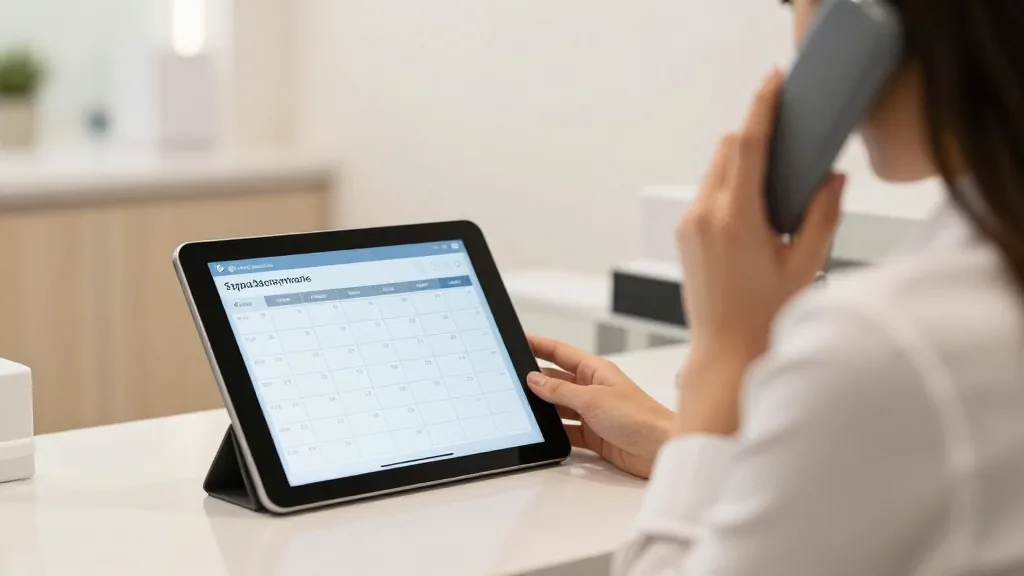
This guide covers the real problem, how the technology works in a clinical context, what a capable system handles, and the handful of questions that separate a genuinely useful AI receptionist from an expensive voicemail upgrade. It is written for clinic owners and practice managers who want to understand the category before committing.
The phone problem most clinics never fully quantify
How many calls reach your clinic on a busy Tuesday while your team is with patients? How many of those go to voicemail? And of those, how many callers actually leave a message — versus how many hang up and try elsewhere?
Veterinary front desks face a structural tension: the work that generates revenue — exams, procedures, check-ins — happens in rooms away from the phone, and the work that leads to that revenue — scheduling those visits — happens at a desk that cannot be in two places at once. Add prescription refill requests, vaccine-reminder callbacks, post-op care questions, and boarding inquiries, and a single receptionist is managing a call volume that was designed for a practice half the current size.
The voicemail black hole
Voicemail compounds every gap. Callbacks go out at the end of the day — after the missed caller has already booked elsewhere — or they don't go out at all because the stack of messages is still growing when the last staff member leaves. A pet owner calling to schedule a sick-pet visit that keeps getting pushed to tomorrow's callback queue is not just a lost appointment; it is a pet whose care is delayed and an owner who will remember that experience when it is time to choose a clinic next year.
The no-show cost hiding in the schedule
No-shows in a veterinary practice waste supply preparation, block slots for patients who wanted them, and disrupt clinical flow for the entire day. Most clinics know their no-show rate. Fewer have a consistent, staff-independent process for reminder texts and confirmation calls — because that process requires someone to send them, which requires time that the front desk usually does not have. Every reminder that doesn't go out is a gamble on whether the client remembered.
What AI phone answering actually does for a veterinary clinic
An AI phone answering system for a veterinary clinic picks up every incoming call — instantly, every time, whether it is 9 a.m. on a Monday or 11 p.m. on a holiday weekend. It understands what the caller wants in natural, conversational speech, draws answers from your clinic's real information, and handles the most common call types end-to-end in English, Spanish, and Chinese. A capable system covers:
- Appointment scheduling and rescheduling — capturing species, reason for visit, preferred vet, date, and contact details, then sending an SMS confirmation to the client.
- Prescription refill routing — logging the pet name, medication, and best callback number, then routing the request to the right technician rather than a shared voicemail pool where it ages until someone finds it.
- Clinic FAQs — hours, parking, accepted species, payment types, boarding availability, what to bring to a first visit, and vaccine requirements.
- After-hours inquiries — directing callers to your designated emergency partner for urgent situations, and handling routine requests without waking anyone.
- SMS appointment reminders — outbound confirmations that cut no-show rates without pulling a staff member from the exam room to make calls.
- Multiple simultaneous calls — all three callers during a busy exam block get answered at once, not routed to voicemail because one line is already in use.
To understand how the voice AI and POS layers connect under the hood, the KwickPhone architecture walkthrough is worth reading before evaluating any specific platform.
After-hours is where the real gap shows
Most veterinary clinics post an after-hours emergency number — but covering those calls for routine inquiries means a person on standby or an answering service charging by the minute that cannot reschedule appointments. AI phone answering closes this gap differently: it is always on, at the same cost, following your exact after-hours protocol.
A caller asking "do you have Saturday morning appointments?" at 9:30 p.m. gets a real answer, not voicemail. A caller asking about boarding rates gets accurate information from your current pricing, not a generic "call back during business hours." A caller who dials the wrong number gets a friendly correction, not dead air. And a caller reporting a possible emergency gets directed immediately — not after a menu of prompts.
This permanent availability is one of the sharpest advantages over even an excellent human front desk: the system never clocks out, never takes a sick day, and never makes an anxious pet owner feel like an imposition for calling outside the 9-to-5 window.
The emergency handoff — the behavior that matters most
This is the single behavior an AI veterinary receptionist must get right, and it is non-negotiable. When a caller describes a pet that has been hit by a car, is having a seizure, has ingested something potentially toxic, or is not breathing — the system must immediately direct them to emergency services or your designated emergency partner and offer to connect them. It must not continue a scheduling flow, ask for vaccine records, or suggest booking a next-available appointment. The right response is clear, fast, and correct every single time.
Other handoff triggers
Beyond true emergencies, a well-built system transfers to a human when:
- The caller explicitly asks to speak with a person or a veterinarian — caller preference always wins, without friction or persuasion.
- The caller is seeking clinical judgment now, not at a scheduled appointment: "should I bring her in today or wait?"
- The request is genuinely outside what the system can safely complete.
The goal is to absorb the high volume of routine calls — scheduling, refills, hours, directions — so your team is fully available for the calls that need a human mind and professional judgment. A system that traps callers in a loop with no clear escape is a worse experience than the missed call it replaced.
How the numbers look without and with AI phone answering
| Scenario | Without AI phone answering | With AI phone answering |
|---|---|---|
| 3 calls arrive during an exam | 2 go to voicemail; one caller hangs up | All 3 answered simultaneously, no hold time |
| After-hours appointment request | Voicemail, returned next business day | Scheduled immediately; SMS confirmation sent |
| Prescription refill request | Staff log and route manually from messages | Logged and routed to the right technician |
| "Do you see exotic birds?" | Voicemail or placed on hold | Answered from your clinic's real species list |
| Pet owner speaks Spanish | Receptionist may struggle to complete the call | System continues in Spanish automatically |
| Caller reports a possible emergency | May reach voicemail after hours | Immediately directed to emergency services |
| Caller asks to speak with a person | Transferred when staff are available | Transferred immediately, no friction |
Multilingual service across a diverse patient base
Many veterinary clinics serve neighborhoods where a meaningful share of pet owners are most comfortable in Spanish or Chinese. An AI phone answering system that handles all three languages — and detects the caller's preferred language within the opening sentence — raises the quality of service for every caller without requiring multilingual staffing on every shift.
The same clinic information comes back accurately in the caller's language: hours, accepted species, boarding rates, directions, what documents to bring. For scheduling, the same appointment logic applies — species, reason for visit, preferred time, contact number — captured cleanly regardless of which language the conversation happens in. This is a first-class capability, not a translation overlay, so the caller's experience is as fluent as it would be in English.
Prank and abuse detection
A busy clinic can attract occasional nuisance calls that waste staff time or, more seriously, attempt to generate bogus appointment slots or prescription requests. A well-built AI phone answering system recognizes patterns consistent with abuse, declines to act on them, and can flag repeat callers for staff review rather than processing each call as though it were legitimate. This is not the primary selling point, but it matters in practices that have dealt with it before.
Owner controls and clinic-specific customization
A capable platform puts the clinic owner in control without requiring a developer or a support ticket for every change.
- Per-clinic Playbooks. Rules that encode exactly how your practice runs: always ask for the pet's name before the owner's; route all surgical consultations to a specific vet; never promise same-day sick appointments on Mondays without checking; always offer to send a new-client intake form by SMS.
- Voice and persona choice. A library of 20+ voices and persona styles — choose one that fits your practice's character, whether that is warm and neighborhood-friendly for a small community clinic or crisp and efficient for a high-volume urban hospital.
- Instant updates. Change your hours, close for a holiday, update your emergency partner information, or mark a service as temporarily unavailable — immediately, without waiting for a support team to propagate the change.
The KwickPhone trade hub shows how these controls are configured across different business types. Transparent pricing is available without a sales call.
Integrations and how the data flows
KwickPhone is native to KwickOS and integrates with Square, Clover, Loyverse, Epos Now, and Revel — so if your clinic's billing and scheduling runs on one of those platforms, appointment data and client records flow directly into the system your team already uses. For clinics running specialized veterinary practice management software, KwickPhone operates as a front-of-house call layer: it captures structured appointment requests, prescription routing notes, and client details, then delivers them to the right person rather than a shared voicemail queue that everyone avoids.
The integrations directory shows each connector's current status and required credentials. The KwickPhone blog covers deployment patterns for different clinic types if you want to see how others have approached the setup.
A useful test when evaluating any platform: ask exactly what happens after the caller hangs up. If the answer is "it sends your staff a transcript" or "it creates a ticket someone needs to confirm," that is manual re-entry wearing a smarter coat. The value is in the system completing the action — a structured appointment request in the right hands, not a recording in a shared inbox.
Setup: keep your existing number
You do not change your clinic's phone number. You keep your existing line and forward calls to the AI. On a traditional landline this is typically a call-forwarding code — commonly *72 followed by the forwarding number to enable, and *73 to disable — though the exact code varies by carrier, so confirm with yours before activating. On VoIP, you point the number in your provider's dashboard.
You can choose to forward all calls, only the ones your staff does not answer within a set number of rings, or only calls outside business hours. That last option is common for clinics that want the AI to handle overflow and the after-hours window while the human team manages the front desk during core hours. Setup does not require a new number, new hardware, or changes to how your existing phones work.
See AI phone answering built for busy practices
KwickPhone answers every call 24/7, handles scheduling, refills, and FAQs end-to-end, and transfers to a human the moment it is the right call. Want to hear how it actually sounds before you decide? Call our live demos at /#try — real lines, not canned recordings.
Book a demoFrequently asked questions
What is AI phone answering for veterinary clinics?
A voice assistant that answers every incoming call to your clinic 24/7, handles common requests — scheduling, hours, prescription routing, FAQs — in natural language across English, Spanish, and Chinese, and transfers to a human for anything requiring clinical judgment or a personal touch.
Can AI handle after-hours calls for a vet clinic?
Yes. The system is always on, so after-hours callers get accurate information about emergency services, your clinic hours, or can leave a structured callback request — without requiring staff to monitor a separate on-call line for routine inquiries.
What happens when a pet owner calls with an emergency?
A well-configured system recognizes emergency language and immediately directs the caller to emergency services or your designated emergency partner, then offers to connect them. It does not continue a routine scheduling flow when a caller describes an urgent situation.
Does AI phone answering work with veterinary practice management software?
KwickPhone integrates natively with Square, Clover, Loyverse, Epos Now, and Revel. For clinics using specialized veterinary practice management software, it operates as a front-of-house call layer that captures structured data and routes it appropriately. The integrations page lists each connector's current status and required credentials.
Do I have to change my clinic's phone number?
No. You keep your existing number and forward calls to the AI — using a call-forwarding code like *72 on a traditional landline (exact codes vary by carrier) or a setting in your VoIP provider's dashboard. You can forward all calls, only unanswered ones, or only after-hours calls.
Related: the complete guide to AI phone answering for restaurants and the best AI phone answering services for restaurants in 2026.