AI Phone Answering for Thai Restaurants (2026)
Thai menus drive more phone calls per cover than most casual-dining categories—and the reason is right there on your laminated pages. Spice level one through five. Protein swaps from beef to tofu. "Is there peanut in the panang?" "My daughter is allergic to shellfish—can I get the tom kha with chicken only?" These are not edge cases. They are every third call on a busy evening, from guests who have been burned by assumptions before and need to ask. And when they hit at 6:45 on a Friday—kitchen eight tickets deep, host seating a walk-in—the phone goes unanswered.
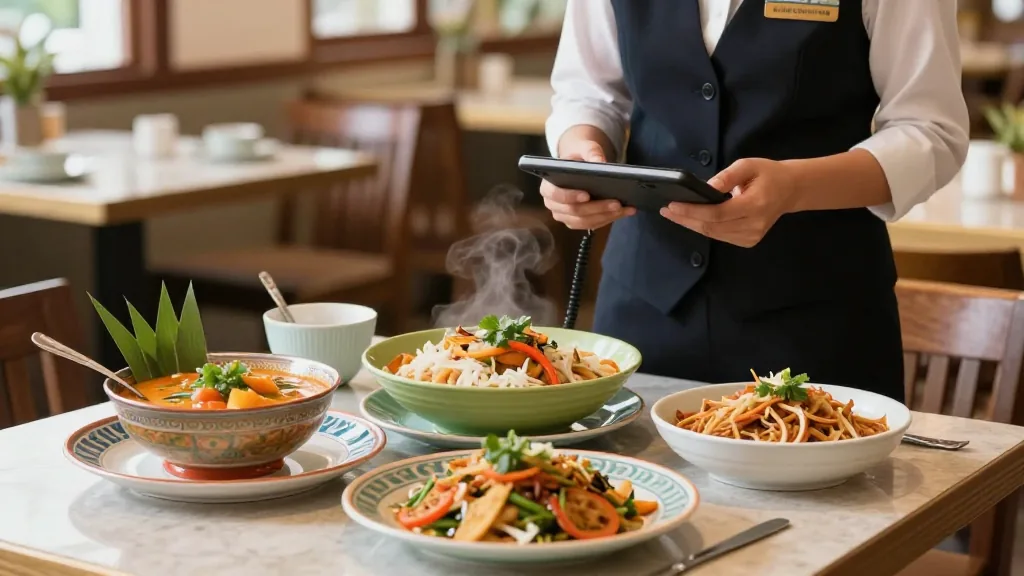
AI phone answering is software that picks up every call, talks naturally with the caller, and handles the task—taking an order, booking a table, answering an allergen question—without tying up your staff. This guide is for Thai restaurant owners who want an honest account of what the technology can and cannot do before they decide.
Why Thai Restaurants Have a Bigger Phone Problem
Thai food is customizable by design. Most dishes on a typical Thai menu carry a spice scale, and a meaningful share of items offer protein, noodle, or base substitutions that callers feel they must confirm before ordering—because they have been burned before, or because the allergen stakes are real. That inherent complexity drives calls that a pizza shop or a burger counter simply does not receive.
Layer in a neighborhood with a mix of English, Spanish, and Chinese speakers and you have a restaurant where the phone is a genuine service channel that no app fully replaces—because many of your guests prefer to ask before they order. During dinner service those calls arrive in waves that match exactly when your staff is least available. On a traditional phone system, the third caller during the rush hears four rings and voicemail. That caller usually does not leave a message.
What AI Phone Answering Does
An AI phone agent answers your restaurant's phone, speaks naturally with the caller, and completes the request end to end. The best systems work 24/7, handle multiple calls simultaneously, and never put a guest on hold. The caller talks the way they would to a host—"pad thai with shrimp, spice three, and a spring roll on the side"—and the system understands the item, the modifier, and the quantity, confirms the order back, and places it.
A real system does not merely write down what the caller said. It completes the task: writing the order into your point-of-sale, firing it to the kitchen, and confirming a pickup time—or booking the reservation in your floor plan.
| Thai restaurant scenario | Traditional phone | AI phone answering |
|---|---|---|
| "Pad see ew, tofu, no egg, spice 2" during the dinner rush | Goes to voicemail; caller orders elsewhere | Answered immediately; order on the kitchen line |
| "Table for four Saturday at 7?" | Rings unanswered | Reservation booked; confirmation texted |
| "Does the green curry have peanuts?" at 10 pm | Voicemail; no answer until morning | Answered accurately from your real menu |
| Two calls arrive at the same moment during service | One goes to voicemail | Both answered simultaneously |
| Caller speaks Spanish; staff speaks Thai and English | Communication gap or lost order | Spanish detected; order completed in Spanish |
The POS Test: Does It Complete the Order?
Many phone bots hold a conversation fluently. Far fewer complete the action inside the system your restaurant actually runs on. When you evaluate any vendor, ask exactly what happens after the caller hangs up. If the answer involves a transcript, a ticket someone must confirm, or a staff member re-entering the order—that is manual re-entry dressed in a modern interface.
Rule of thumb: a phone agent that cannot reach your POS is a fancy answering machine. The value is in completing the task end to end—the order on the kitchen line, the reservation in the floor plan—not a note on a screen your staff still has to act on.
KwickPhone is native to KwickOS and integrates as an open service with Square, Clover, Loyverse, Epos Now, and Revel. After the call, the ticket is already where your kitchen team looks. Nothing is re-keyed, and nothing waits for a person to confirm.
The Thai Menu Challenge: Modifiers, Spice Levels, and Allergens
A Thai restaurant AI is only as good as what it is grounded against. Grounding means the assistant is trained on your real menu, your real modifiers, and your real policies—so it cannot invent a dish you do not carry or promise a substitution you do not offer. For a Thai restaurant, proper grounding includes:
- Spice levels per item — the system applies the caller's chosen level to the correct dish and reads it back for confirmation before placing the order.
- Protein substitutions — which dishes accept chicken, beef, tofu, shrimp, or seafood, and which do not, mapped to your actual menu.
- Noodle and base choices — rice noodle versus egg noodle, jasmine rice versus brown rice, wherever those options exist on your menu.
- Allergen knowledge — which dishes contain peanuts, shellfish, gluten, or dairy, answered from your actual recipes rather than a generic database.
The system also tracks context across the conversation. When a caller says "make the second one a four and the first one a two," it knows which dishes those refer to—without asking the caller to repeat themselves.
Multilingual Service—English, Spanish, and Chinese
For most Thai restaurants in urban and suburban markets, multilingual service is not a luxury—it is the difference between a caller completing their order and hanging up. KwickPhone supports English, Spanish, and Chinese, and detects the caller's language within the opening sentence, switching automatically without requiring the caller to navigate a menu.
The same menu grounding applies in every language. A Spanish-speaking caller's order for pad see ew with chicken, spice two, maps to the same kitchen ticket an English-speaking caller's order would—with the same modifiers, the same allergen checks, and the same confirmation read-back. You do not need multilingual staff on every shift to serve a multilingual neighborhood.
Handling the Rush: Concurrency, Prank Calls, and Smart Handoffs
Concurrent calls during service
A human host answers one call at a time. KwickPhone answers as many as ring simultaneously, so the second and third caller during your Friday dinner rush each reach a live host instead of voicemail. This is where the most consistent value accumulates: not in any single call handled more efficiently, but in the calls that previously overflowed and went elsewhere.
Prank detection and knowing when to hand off
KwickPhone recognizes the signals of prank or abusive calls—repeated suspicious order patterns, unusual item combinations, hostile language—and declines to act on them rather than firing bogus tickets to your kitchen. Known offenders can be flagged so the system does not keep engaging the same caller.
Equally important is knowing when to transfer to a person. KwickPhone hands off when:
- The caller asks to speak with a person—caller preference always wins.
- The order is unusually large, a catering inquiry, or from a VIP who deserves a personal conversation.
- The request is genuinely outside what the system can safely complete.
The goal is to handle the routine, high-volume calls—pickup orders, reservations, hours, allergen questions—so your team can give full attention to the guests who need a human. A phone agent that traps callers with no exit is a worse experience than the missed call it replaced.
Owner Controls and Playbooks
KwickPhone puts the restaurant owner in control without requiring technical expertise. A library of 20+ voices and personas lets you choose how the AI host sounds—a warm, casual neighborhood voice or something more refined—and switch as your concept evolves.
Per-merchant Playbooks encode the rules of your specific restaurant: always ask about spice preference before moving to the next item, offer the mango sticky rice at the end of every order, never promise pickup in under 20 minutes when a rush is in progress, route any catering request directly to the manager. Playbooks are your institutional knowledge formalized—so the AI runs your way, not a generic template adapted from a different type of restaurant.
You can also update hours, mark an item sold out, or pause ordering using a voice command—useful when you are in the kitchen, not at a laptop.
Setup: Keep Your Number
You do not need a new phone number. You keep your existing line and forward calls to KwickPhone. On a traditional landline this is typically a call-forwarding code—commonly *72 followed by the forwarding number to activate, and *73 to cancel—though the exact codes vary by carrier, so confirm with yours before you set up. On VoIP, you redirect the number in your provider's dashboard.
You can choose to forward all calls, only calls your staff do not pick up, or only calls outside business hours—so the AI becomes your after-hours host while your team runs the floor during service. Your existing number stays put, and your guests never notice the change.
Hear it handle a real Thai menu order
KwickPhone answers every call and places the order natively into your POS—or bolts onto the system you already run. Curious how it sounds on a real call? Try the live demo lines at /#try—not canned recordings.
Book a demoFrequently Asked Questions
Can AI phone answering handle Thai menu modifiers like spice level and protein swaps?
Yes, provided the system is grounded on your actual menu. A well-built AI tracks spice level per item, applies protein substitutions where you offer them, and handles noodle-or-rice decisions—then confirms all choices back to the caller before placing the order.
Does it work if my customers speak Spanish or Chinese?
KwickPhone supports English, Spanish, and Chinese, and detects the caller's language automatically. The same menu grounding—modifiers, allergens, substitutions—applies in each language, so the order that lands on your kitchen line is correct regardless of which language the caller used.
Will it place the order into my POS, or just take a message?
KwickPhone completes the order in your POS—native to KwickOS and integrated with Square, Clover, Loyverse, Epos Now, and Revel. The ticket lands on your kitchen line without any staff re-entry. Phone agents that only transcribe calls leave your team with a note to re-key, which defeats the purpose.
What happens when a caller wants to place a large catering order?
KwickPhone transfers catering requests and unusually large or complex orders to a human. The handoff is clean: the AI flags the call type and routes it to your staff. You configure the threshold in your Playbook so the AI knows your definition of "large."
Do I need a new phone number to set this up?
No. You keep your existing number and forward calls using a call-forwarding code—often *72 on a landline (codes vary by carrier, so confirm with yours)—or through your VoIP provider's dashboard. You can forward all calls, only unanswered ones, or only calls outside business hours.
Related: the complete guide to AI phone answering for restaurants and the best AI phone answering services for restaurants in 2026. To hear KwickPhone handle a real call, try the live demo lines at /#try—real lines, not canned recordings.