AI Phone Answering for Mediterranean Restaurants (2026)
It's 6:45 on a Thursday and the shawarma cone is packed, the grill is loaded with kofta, and a family of eight just walked in without a reservation. The phone rings. It's someone who wants a $140 mixed-grill platter for pickup in forty-five minutes—exactly the kind of order that pays your rent. Nobody can pick up. It rings out. They call the place two doors down instead. You never even knew the call happened.
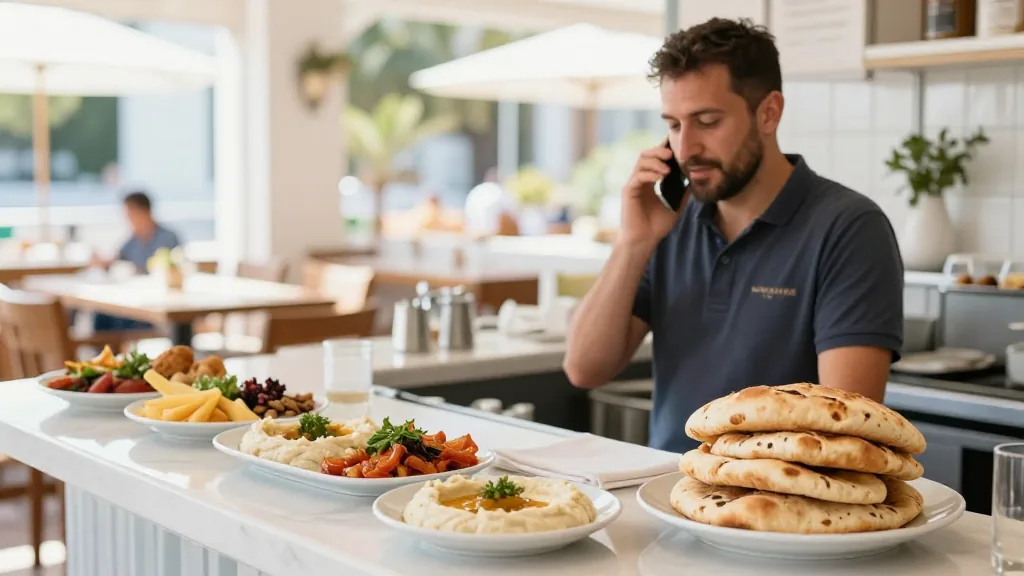
That scene is the quiet tax on a busy Mediterranean kitchen. The food is labor-intensive, the platters are big-ticket, and the phone doesn't care that both hands are covered in garlic sauce. AI phone answering for Mediterranean restaurants is the fix: software that answers every call, talks like a real host in the caller's own language, and drops the order straight into your POS—no voicemail, no re-keying, no lost platter.
The calls a Mediterranean spot actually misses
Not all missed calls are equal. A pizzeria loses a $22 order; a Mediterranean restaurant loses calls that skew larger and more complicated. Here's where the money leaks:
The family platter and catering call
Mezze spreads, mixed grills, party trays of falafel and hummus, whole-lamb requests for a graduation—these callers are ready to spend real money, and they have questions. How many does the large platter feed? Can you do it with no dairy? Is baklava included? If that call hits voicemail, it doesn't wait. It books somewhere that answers.
The dietary-question call that never converts
Vegan, gluten-free, halal, nut allergies—Mediterranean menus attract careful eaters, and they call before they order. "Is the rice cooked in chicken stock?" "Is the pita brushed with butter?" A voicemail can't answer that, so the caller assumes the worst and moves on. A grounded AI answers from your real ingredient notes.
The after-hours and prep-time call
People plan tomorrow's office lunch at 9pm. They call to ask if you're open Sunday, whether you cater on short notice, how early to order a tray for twenty. When those calls die in an unchecked voicemail, they're gone by morning.
The rush hour pile-up
One host, three lines lighting up at 7pm. Even a great employee can only hold one call. Caller two and three get voicemail or a busy tone. This is the single biggest source of recovered revenue—the calls that overflow, not any one call in isolation.
Do the math with your own numbers: if you miss even three catering-sized calls a week at an average of $120 each, that's illustrative money walking to a competitor every month—money you already had the food and staff to earn.
What "AI phone answering" actually means here
It's a voice assistant that answers your restaurant's phone, understands what the caller wants, and completes the task—takes the platter order, books the table, answers the halal question, texts a payment link, or sells a gift card. It runs 24/7, never puts a guest on hold, and handles several callers at once. Instead of "press 1 for hours," the caller just talks the way they'd talk to your host. If you want the full category background, our complete guide to AI phone answering for restaurants covers the mechanics end to end.
The one thing that separates real value from a fancy answering machine
Plenty of phone bots can hold a conversation. Far fewer can actually place the order into your point-of-sale and fire it to the kitchen. When a bot can't reach your POS, your staff still has to re-type everything it wrote down—slow, error-prone, and it defeats the whole point. You've automated the talking, not the work.
KwickPhone is native to the KwickOS platform, and it also bolts onto the POS you already run as an open service—the integrations page shows each connector's live status and the exact credentials you'll need to link it. That means a Mediterranean plate with "extra toum, no onions, sub brown rice" maps to your real modifiers and lands on the kitchen line, not on a sticky note someone re-keys during the rush.
| Caller's request | Voicemail | KwickPhone |
|---|---|---|
| "Large mixed-grill platter, pickup in 45" | Message; called back too late | Placed in POS, fired to grill, pickup time confirmed |
| "Is the rice cooked with chicken stock?" | No answer; caller assumes yes and leaves | Answered from your real ingredient notes |
| "Table for six at 7:30?" | No response until someone checks | Booked into the floor plan, confirmed by text |
| "Catering tray for 20 tomorrow" | Lost after hours | Details captured; oversized order routed to manager |
| "¿Tienen opciones sin gluten?" | English only | Switches to Spanish automatically |
| Three calls at once, Friday 7pm | Two go to voicemail | All three answered simultaneously |
Language: the neighborhood advantage
Mediterranean restaurants often sit in mixed neighborhoods with regulars who'd rather order in Spanish or Chinese. KwickPhone speaks English, Spanish, and Chinese, and detects the caller's language within the first sentence, then switches automatically. The item and modifier grounding works the same in each language—so a Spanish-speaking regular ordering a chicken shawarma with extra garlic sauce produces the identical clean kitchen ticket an English speaker would. You get fluent, patient service on every shift without hiring multilingual staff for every shift.
Everything it handles beyond taking orders
- Pickup and takeout — placed natively, fired to the kitchen, with an accurate prep time (no promising 20 minutes when the grill is slammed).
- Reservations and waitlist — booked into your floor plan with party size and special requests.
- Dietary FAQs — halal, vegan, gluten-free, nut allergies—answered from your real policies.
- Catering intake — headcount, trays, timing captured; large jobs handed to a human.
- Gift cards and loyalty — balance checks, enrollment, applying rewards.
- Payment by SMS — a secure text link so the caller pays before pickup.
- Reminders and order-ready texts — the kind that cut no-shows on that Friday table.
When it should hand the call to a human
A good system stays in its lane. KwickPhone transfers to a person when the caller simply asks for one—preference always wins—when an order is unusually large, a catering job, or from a known VIP who deserves the owner's ear, or when the request is genuinely unusual. It also detects obvious prank or abusive calls and declines to fire bogus platters into your kitchen. The point is to catch the routine, high-volume calls so your team can give full attention to the ones that need a human touch.
You keep your number and your voice
You don't change your phone number. You forward your existing line to the AI—usually a call-forwarding code like *72 on a landline (codes vary by carrier, so confirm with yours) or a setting in your VoIP dashboard. Forward all calls, only the ones your staff don't grab, or only calls outside business hours so the AI becomes your after-hours host while the team works the floor during service.
On the customization side, you're in charge without needing a developer. Pick from 20+ voices and personas so the assistant sounds like your brand—warm neighborhood taverna or crisp fast-casual counter. Per-merchant Playbooks encode how your place runs: always offer the family platter upgrade, never promise under 30 minutes on a Friday, route any catering tray over a set size to the manager. You can even update hours or flip a sold-out item by voice while your hands are busy.
A worked scenario
Before. Saturday, 7:05pm. The host is seating a walk-in, both servers are running plates, and three lines light up. Line one—a $140 platter for pickup—rings out and orders elsewhere. Line two asks about gluten-free and gives up. Line three, a party of six, goes to voicemail nobody hears until close.
After. Same 7:05pm. KwickPhone answers all three on the first ring. It takes the $140 platter, suggests baklava, confirms a 35-minute pickup, texts a payment link, and drops the ticket on the grill line. It tells the second caller which dishes are gluten-free from your real notes and takes their order too. It books the six-top into the floor plan and texts a confirmation. Your staff never broke stride, and three calls that would've been lost turned into business on the books.
A decision framework for Mediterranean operators
- Does it complete the order in my POS, or just transcribe? Ask exactly what happens after hangup. Check the integrations page for your system—KwickPhone works with Square, Clover, Loyverse, Epos Now, and Revel.
- Is it grounded on my real menu and ingredient notes, so it can answer the halal and allergen questions truthfully?
- How many calls at once? Concurrency is where your rush-hour platters live.
- Does it speak my customers' languages and switch automatically?
- How does it route catering and VIP calls to a human?
- Can I change hours and 86 an item myself, instantly? See pricing and the by-trade hub at /for/ for how it maps to restaurants, plus the ongoing KwickPhone blog for setup walkthroughs.
- Can I hear it before I buy? A real call beats a slide deck.
Hear it take a real Mediterranean order
KwickPhone answers every call, speaks your customers' languages, and places the order natively in your POS—or bolts onto the system you already run. Want to hear it? Call our live demos (real lines, not canned recordings) at /#try.
Book a demoFrequently asked questions
Can AI phone answering handle a large catering order?
It captures the routine details—headcount, platters, pickup or delivery time—but transfers unusually large or high-stakes catering calls to a manager or owner so a person confirms logistics and pricing. Caller preference and VIP orders always route to a human.
Does it place the order into my POS or just take a message?
The systems worth paying for complete the task. KwickPhone places the order natively into KwickOS, or bolts onto Square, Clover, Loyverse, Epos Now, and Revel so the ticket fires to the kitchen line—no staff re-keying a transcript.
What languages can it speak?
English, Spanish, and Chinese. It detects the caller's language in the first sentence and switches automatically, producing the same clean kitchen ticket in any of them.
Do I have to change my phone number?
No. Keep your number and forward calls to the AI line—usually a code like *72 on a landline (codes vary by carrier) or a setting in your VoIP dashboard. Forward all calls, only unanswered ones, or only after-hours calls.
Can it handle several calls at once during the rush?
Yes. Unlike a single host, the AI answers as many calls as ring at once, so the third and fourth caller reach a host instead of voicemail.
Related: the complete guide to AI phone answering for restaurants and the best AI phone answering services for restaurants in 2026.