AI Phone Answering for Hotels & Motels (2026)
At 11:47 p.m. a driver pulls off the highway, two hours behind schedule after a delayed flight. She needs to know whether the motel still has her room, what entrance to use, and whether there's a code for the side door. She dials the front desk number from the road. It rings. And rings. Voicemail picks up, plays a generic recording with no useful information, and beeps. She hangs up and books the place across the street. That call cost a room night—and nobody at your property ever knew it happened.
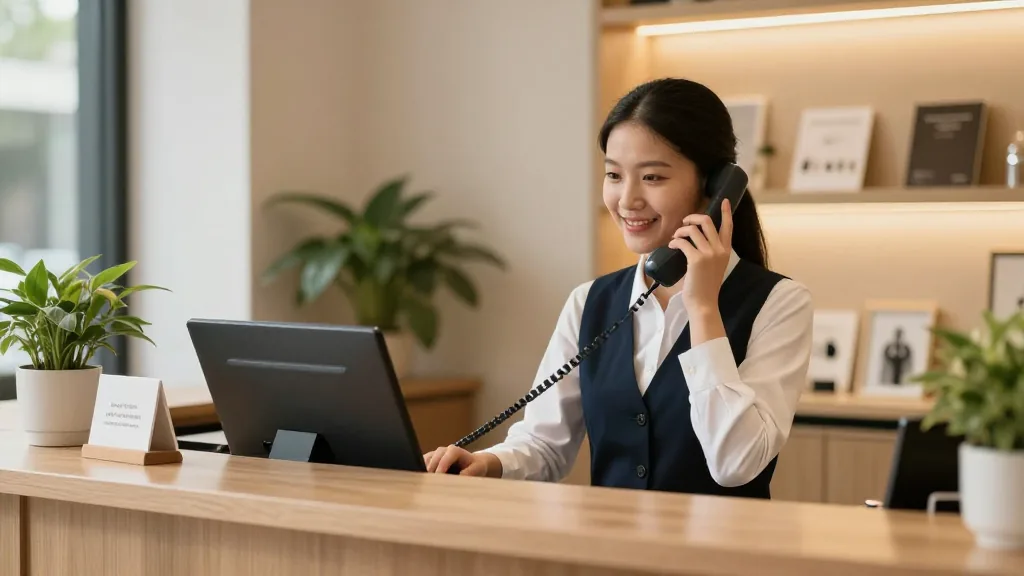
This guide explains what AI phone answering is, why the hotel and motel front desk is one of the highest-leverage places to apply it, what a real system can and cannot do, and how to evaluate one without being sold a demo that falls apart during a real Friday check-in surge. It is written for independent property owners and operators who want to understand the category before they decide.
The front desk gap every hotel owner recognizes
The phone is still the primary contact channel at most independent hotels and motels. Guests call to confirm reservations, ask about parking and pet policies, get the Wi-Fi password before they arrive, inquire about late check-in, and sometimes just need directions because the GPS sent them somewhere wrong. These are routine calls—but at smaller properties, "routine" doesn't mean "covered." Here is the pattern almost every owner knows:
- Missed calls during arrival rushes. Friday check-in, holiday eves, and group arrivals leave the front desk fully occupied with guests in line. The phone rings in the background. Nobody can break away. It goes to voicemail.
- The voicemail black hole. Guests who leave a message rarely get a timely callback. By the time someone listens, the caller has booked elsewhere, arrived confused, or showed up without the information they needed.
- After-hours gaps. Many independent properties run a thin overnight shift—or route calls to a cell phone that isn't always answered. A guest arriving at 1 a.m. asking about the keypad code hits dead air at the exact moment they most need help.
- Re-keying reservation inquiries. When a front desk agent does take a phone message about a rate inquiry or change, that information has to be manually entered into the property's system—adding time and the risk of errors.
- Language barriers. A property near an airport or tourist corridor fields calls in more languages than any single staff member speaks. The traveler who hangs up because nobody understood them may have been a regular.
- No-shows tied to unanswered calls. Guests who can't confirm reservation details—especially at properties that don't use a major booking platform—may simply not show, leaving a room empty with no recourse.
None of these failures are about effort. They are structural: a phone channel that rings at all hours, served by staff who can only answer one call at a time, with no coverage when hands are full or the desk is unstaffed. AI phone answering is the structural fix.
What is AI phone answering for hotels and motels?
It's a voice assistant that answers your property's phone on the first ring, understands the caller in natural language, and handles the request—checking hours and policies, answering questions about amenities, confirming reservation details, routing urgent calls to the right person, capturing what needs staff follow-up. The best systems work 24/7, handle as many simultaneous callers as ring at once, speak multiple languages, and know when a call needs a human and when it doesn't.
The label varies—AI front desk, AI receptionist, AI phone agent—but the test is the same: does it actually help the caller, or does it park them in a slightly fancier voicemail?
How the technology works
Three layers operate below the surface of every smooth-feeling call.
Speech understanding
The system answers instantly and converts speech to text in real time, then interprets the caller's intent. Good voice AI handles natural, conversational speech—"Hi, uh, I have a reservation for tonight, I think it's under Johnson, and I just wanted to make sure the room is still held because our flight got delayed"—across accents, background noise, and mid-sentence corrections. It tracks context through the call, so follow-up questions refer naturally to what was just said.
Property grounding
This is the step that separates a real assistant from a generic chatbot. The system is grounded against your actual property information: check-in and check-out times, parking rules, pet policy, pool hours, breakfast details, accessibility, the Wi-Fi network name and password, room types, after-hours entry instructions. When a caller asks "do you have a pool?" the answer comes from your property's facts, not from a hallucinated guess. When they ask for the Wi-Fi password, they get the real one.
Acting on the call
After understanding the request and grounding it against your property, the system responds—and for anything requiring a next step, it routes the call to the right person, texts a confirmation to the guest, or logs the request where staff will see it when they're back at the desk. For properties that run an on-site café, gift shop, or restaurant on Square, Clover, Epos Now, Loyverse, or Revel, KwickPhone can also handle those orders natively within the same call—the integrations hub documents every supported connector and the credentials each requires.
After hours is where smaller properties feel it most
A large full-service hotel has overnight staff. A 30-room motel on a state highway often does not—or has one person managing the desk who can't be on the phone and checking in a late arrival simultaneously. This is where the gap costs the most: the traveler who calls at midnight to confirm a late check-in gets no answer and makes a different plan.
AI phone answering has no shift. It answers the same at 2 a.m. as at 2 p.m.—confirming whether a reservation is still held, explaining the after-hours entry procedure, answering questions about the nearest pharmacy or gas station, and capturing any request (a noisy neighbor complaint, a wake-up call request, a missing towel) that needs staff attention the moment someone is back at the desk. The blog covers this more deeply in how independent businesses handle after-hours calls without a call center.
A useful frame: your front desk is staffed for the average. AI phone answering covers everything outside that average—the delayed flight, the holiday weekend surge, the 3 a.m. question—without adding headcount or overtime.
Everything a real AI front desk handles for hotels
The full surface area of a capable system at a hotel or motel includes:
- Reservation confirmation and details — confirming a booking is on file, reading back the check-in date, room type, and rate.
- Property FAQs — check-in/out times, parking, pets, pool hours, breakfast, accessibility, smoking policy.
- Directions and arrival instructions — including late-arrival keypad codes and where to park after the office closes.
- Late check-in handling — explaining the procedure and flagging the arrival so staff are prepared.
- Amenity questions — Wi-Fi credentials, gym hours, laundry location, vending floors, ice machines.
- Availability inquiries — routing to booking channels or capturing lead information for staff follow-up.
- Complaint and request intake — logging urgent in-stay issues (HVAC problem, noise complaint) and routing to the on-call number immediately.
- On-property F&B or retail orders — for hotels with a café or gift shop on a compatible POS, orders placed natively on the same call.
- Payment by SMS — texting a secure link for phone-confirmed charges so guests pay before pickup or arrival.
- Follow-up text confirmations — after a late check-in briefing or reservation inquiry, the guest gets the details in writing on their phone.
| Guest's call | Unanswered / voicemail | Real AI front desk |
|---|---|---|
| "Is my reservation still good? Flight's delayed." | Message left; callback the next morning | Confirms booking, explains late check-in procedure, texts the door code |
| "Do you allow dogs?" | Recording with no pet policy info | Answers from your live policy; notes any breed or size restrictions |
| "What's the Wi-Fi password?" | Voicemail; guest arrives without it | Reads the network name and password, offers to text it |
| "¿Hablan español?" | English-only recording or silent hang-up | Switches to Spanish automatically, handles the full call |
| Three calls at once during Friday check-in | Two go to voicemail | All three answered simultaneously, no one on hold |
| "I need to speak with the manager." | Buried in voicemail queue | Transfers immediately to the on-call number |
Multilingual service at the front desk
Hotels and motels near airports, interstate corridors, and tourist areas routinely receive calls from guests who are more comfortable in Spanish, Mandarin, or another language. A single front desk agent can't cover every language, and a caller who can't communicate their question clearly often hangs up frustrated—or avoids calling altogether and arrives with unmet expectations that become a problem at check-in.
KwickPhone detects the caller's language within the first sentence and switches automatically—serving English, Spanish, and Chinese fluently, with the same property grounding in each. A caller asking "¿tienen estacionamiento gratis?" gets an accurate answer drawn from your actual parking policy, not a fumbled approximation. For a property in a diverse market or near international transit, this is often the most immediately visible improvement in call quality. The by-trade hub has more on how multilingual phone coverage applies across different hospitality settings.
Handling real-world complexity
Concurrent calls — no overflow voicemail
A single front desk agent handles one call at a time. On a busy Friday when a tour group arrives, two walk-ins queue at the desk, and three phones ring in a row—those callers hit voicemail. AI answers as many simultaneous calls as ring. Every caller gets a response, even during the worst arrival window. This is often where the most recoverable service failures hide: not in any single dropped call, but in the pattern of calls that overflow every peak period without anyone noticing.
Prank and abuse detection
The system recognizes obviously abusive or prank calls and declines to engage or act on them. It can flag repeat problem callers rather than routing them to staff attention every time.
Knowing when to hand off to a human
A well-built assistant stays in its lane. It transfers to a person when:
- The caller simply asks for a human—caller preference always wins.
- The call involves a VIP guest, a large group booking, or a complex rate negotiation that deserves a personal conversation.
- The request is outside what the system can safely handle—an unusual complaint, a billing dispute, a situation that needs judgment it doesn't have.
The goal is to resolve the routine, high-volume calls automatically—freeing front desk staff for the guests standing in front of them—not to wall callers off from a person. A system with no escape hatch creates a worse experience than the missed call it replaced. See how KwickPhone routes and escalates calls for the full handoff logic.
Owner and GM controls
The best platforms give the property owner or general manager direct control without requiring IT support or a support ticket. Look for:
- Per-property Playbooks. Rules that encode how your property operates: always text the after-hours door code to late arrivals, never confirm availability without checking the desk first, transfer any complaint about a specific room to the manager's cell.
- Voice and persona choice. A library of 20-plus voices and personas so the assistant's tone matches your brand—warm and relaxed for a roadside motel, polished and precise for a business hotel.
- Live updates by voice command. Change the Wi-Fi password, update the late-arrival code, flag a room as out of service—by speaking a secure command, without logging into a dashboard at midnight.
What each configuration option requires is documented on the integrations page. For pricing by call volume and property size, see the pricing page.
Setup: keep your existing number
You do not change your phone number. You keep the number guests already have and forward calls to the AI. On a traditional landline this is typically a call-forwarding code—commonly *72 followed by the forwarding number to turn it on, and *73 to turn it off—though exact codes vary by carrier, so confirm with yours. On VoIP, you update the routing in your provider's dashboard. You can forward all calls, only calls that go unanswered after a set number of rings, or only calls outside your defined front desk hours—so the AI becomes your overnight and overflow layer while your team handles in-person guests during the day.
A step-by-step walkthrough of the forwarding process is at setting up AI phone answering with call forwarding. You can also call our live demos at /#try—real lines, not canned recordings—to hear exactly how the system sounds before committing to anything.
See AI phone answering built for the hospitality front desk
KwickPhone answers every call 24/7—check-in questions, after-hours arrivals, multilingual guests, concurrent surges—and routes anything that needs a human directly to your staff. Hear it live at /#try, or talk through your property's setup with us.
Book a demoFrequently asked questions
What is AI phone answering for hotels and motels?
A voice assistant that answers the property's phone 24/7, understands the caller in natural language, handles routine requests—check-in time, parking, amenities, directions, reservation inquiries—and routes complex or VIP calls to staff without missing a single ring.
Does it work after hours and overnight?
Yes. AI phone answering has no shift and no overtime cost. It answers the same at 2 a.m. as at 2 p.m.—confirming reservations, explaining late check-in procedures, and capturing any request that needs staff follow-up so nothing falls through the cracks.
Can it transfer the call to a front desk agent or manager?
Yes. It transfers when the caller asks for a person, when a booking is unusually complex or from a VIP, or when the request is outside what it can safely handle. The goal is to resolve routine calls automatically and surface the ones that genuinely need a human.
What languages does it support?
Commonly English, Spanish, and Chinese, with automatic language detection in the first few words. International guests and non-English-speaking locals get a patient, fluent response without requiring multilingual staff on every shift.
Do I have to change my hotel's phone number?
No. You keep your existing number and forward calls to the AI—typically via a code like *72 on a landline (codes vary by carrier) or a routing setting in your VoIP dashboard. Forward all calls, only unanswered ones, or only after-hours calls, depending on your staffing model.
Related: the complete guide to AI phone answering for restaurants and the best AI phone answering services compared for 2026.